Introduction
Golf is a game where small differences in distance can influence club selection, target selection, and overall course management. A player standing 150 yards from a green may have several questions to answer before making a shot. Is the flag near the front or back? Is the green elevated? Is there a bunker between the player and the target? How far is a safe landing area? Does the hole play uphill or downhill?
Traditional yardage markers provide useful information, but they cannot necessarily answer every one of these questions. A laser golf rangefinder approaches the problem differently. Instead of relying exclusively on fixed course markers or mapped GPS information, the player can aim at a visible target and receive a direct distance measurement.
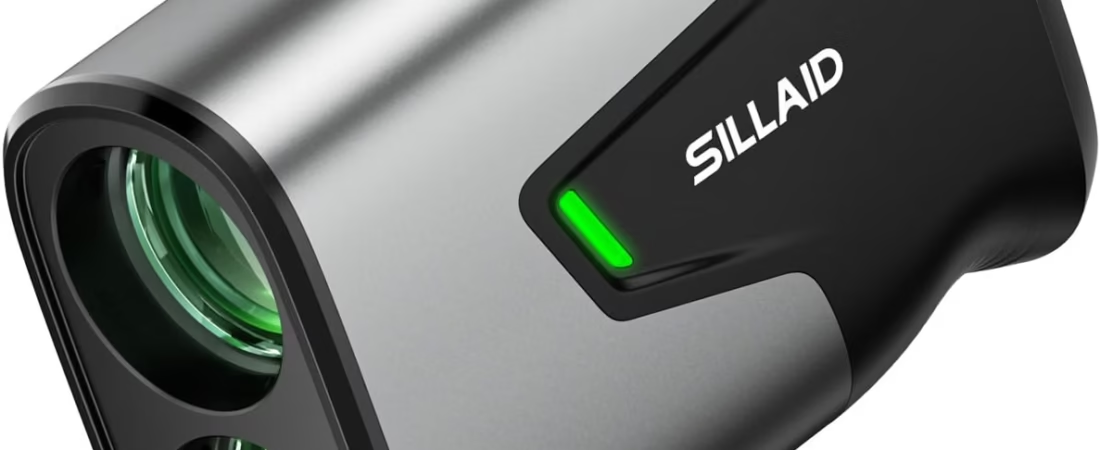
The Golf Rangefinder with Slope, 1200 Yards Range Finder, 7X Magnification with Pin Lock Vibration, 23.5mm Ultra Lens, Magnetic, Rechargeable Laser Rangefinder is designed around this approach. The Amazon product title identifies several of its principal features, including a stated 1,200-yard range, 7X magnification, slope functionality, pin-lock vibration, a 23.5 mm optical lens, magnetic attachment, rechargeable operation, and a configuration intended for tournament use.
Because the product listing itself is the primary reference for these particular specifications, it is useful to distinguish advertised capabilities from the broader question of how a golf laser rangefinder actually performs on a course. A maximum range, for example, does not mean that every target will be equally easy to acquire at that distance. Likewise, slope information can provide additional context for a shot, but it does not automatically determine which club a golfer should use.
This guide explains how this type of golf rangefinder works, what its major features mean in practical terms, how it can be incorporated into course management, and what golfers should consider before choosing a laser rangefinder.
What Is a Golf Laser Rangefinder?
A golf laser rangefinder is a compact optical device that measures the distance to a selected target.
The basic process is simple:
- The golfer looks through the optical system.
- A visible target is selected.
- The rangefinder sends a laser toward that target.
- The device analyzes the returning signal.
- The measured distance appears in the viewing display.
The target does not have to be the flag.
A golfer can potentially measure:
- Flagsticks
- Trees
- Bunkers
- Water hazards
- Fairway landmarks
- Layup points
- Green-side features
- Other visible course objects
This flexibility is one of the primary differences between a laser rangefinder and a fixed yardage marker.
A marker may tell the golfer a standardized distance to a particular point, such as the center of the green. A laser allows the golfer to select the object that matters to the decision at hand.
That can make the device particularly useful on unfamiliar courses.
Key Features of the Golf Rangefinder
1,200-Yard Measuring Range
The product is advertised with a maximum measuring range of 1,200 yards.
For ordinary golf shots, most measurements will be considerably shorter than this. Nevertheless, a long stated range can provide flexibility for measuring distant landmarks, trees, hazards, and other objects around a course.
The important distinction is between the maximum advertised range and the practical range for a particular target.
A laser rangefinder does not interact with every object in exactly the same way. A large, reflective target can be easier to acquire than a thin flagstick surrounded by trees. Weather, sunlight, atmospheric haze, target color, and the user’s ability to hold the device steadily can also influence the result.
Therefore, a 1,200-yard specification should be understood as a capability of the device under appropriate conditions rather than as a guarantee of identical performance against every target.
7X Magnification
The product is advertised with 7X magnification.
Magnification enlarges the visual appearance of distant objects through the optical system. This can help golfers identify the flagstick or distinguish a target from objects behind it.
For example, a golfer may be standing several hundred yards away from a green. With the naked eye, the flag can be relatively difficult to distinguish from the surrounding background. Magnification can make the target easier to locate and align with.
There is, however, a practical consideration with higher magnification: hand movement becomes more noticeable.
If the golfer moves the rangefinder slightly while looking through the viewfinder, the target can appear to move considerably more than it would at lower magnification.
A steady grip is therefore important when using a 7X optical system.
23.5mm Ultra Lens
The product title identifies a 23.5 mm ultra lens.
The optical system plays an important role in how comfortably a golfer can identify distant targets.
The objective lens affects how light enters the optical system, while the quality of the complete optical design influences clarity, contrast, and visibility.
The 23.5 mm specification should therefore be considered as one component of the optical system rather than as an isolated indicator of image quality.
Outdoor golf creates changing lighting conditions. A bright sunny afternoon, a cloudy morning, and a shaded area beneath trees can present very different viewing conditions.
Keeping the optical surfaces clean is also important. Fingerprints, dust, and moisture can interfere with visibility.
Pin Lock and Vibration
The rangefinder includes a pin-lock function with vibration feedback.
The purpose of this feature is to help the golfer confirm that the rangefinder has acquired the intended flag or pin rather than another object in the background.
This can be useful when a flagstick is surrounded by trees, buildings, bunkers, or other visual features.
A vibration provides tactile confirmation. Instead of relying exclusively on the displayed number, the golfer can receive a physical signal when the pin-lock process recognizes the intended target.
Target acquisition technology should still be treated as an aid rather than an absolute guarantee.
If several objects are aligned close together, the golfer should remain aware of what the device is measuring and repeat the measurement if the result appears inconsistent with the course layout.
Slope Measurement
Slope measurement is another important feature.
A conventional laser reading provides the direct distance between the golfer and the target. When the target is significantly uphill or downhill, however, the direct distance does not tell the entire story from a shot-planning perspective.
Slope technology considers the elevation difference between the golfer and the target and can provide additional information about the angle and slope-adjusted distance.
Consider two greens that are both 150 yards away.
If one is approximately level with the golfer and the other is significantly uphill, the two shots can require different considerations even though the horizontal location may appear similar.
Slope information gives the golfer another data point when assessing the shot.
It does not account for everything.
Wind, temperature, altitude, lie, ball flight, club characteristics, and the golfer’s normal carry distances remain important.
Slope On/Off Function
A slope switch is particularly relevant to golfers who participate in organized events.
Slope-adjusted information can be restricted under certain competition rules. A rangefinder that allows slope functionality to be disabled can therefore be more flexible for golfers who use the same device during both casual rounds and competitive play.
The phrase “tournament legal” should not be interpreted as a universal approval for every tournament.
Golf’s equipment rules and local competition conditions can differ. A golfer should verify the rules that apply to the specific event.
In general, when slope compensation is disabled and the device is being used only for permitted distance information, it may fit within the applicable rules. However, the event’s governing conditions should always take priority over a product listing.
How Slope Technology Works in Golf
Understanding slope is useful because it is one of the most misunderstood features of modern rangefinders.
Imagine a golfer standing 160 yards from a green that is located uphill.
The laser measures the direct line-of-sight distance between the golfer and the target.
The slope function then considers the elevation difference and can provide an adjusted figure intended to help the golfer understand how the shot may play relative to the raw distance.
This does not mean the rangefinder knows exactly how the golf ball will travel.
It does not know:
- The golfer’s swing speed
- The golfer’s typical carry distance
- The exact wind conditions at different points of the shot
- The quality of the lie
- The golfer’s launch angle
- The ball’s exact flight characteristics
- Whether the player intends to hit a full or controlled shot
Slope is therefore best viewed as an additional piece of information.
A golfer can combine it with personal experience and course conditions.
How It Can Be Used on the Golf Course
Measuring the Flag
The most obvious use is measuring the flagstick.
The golfer can look through the optical system, locate the flag, activate the measurement, and use the pin-lock feedback to help confirm the target.
The resulting distance can then be compared with known club distances.
For example, if a golfer knows their normal carry distance with several clubs, the measured yardage can help narrow the range of possible choices.
The rangefinder does not make the club decision itself.
Measuring the Front and Back of a Green
The flag is not necessarily the only important point.
A golfer may want to know how much green exists beyond the flag or how much distance is required to reach the front.
A laser can potentially be aimed at visible reference points.
This can help the golfer understand whether the flag is positioned toward the front, middle, or back of the green.
However, because the laser measures visible physical targets, the golfer needs a clear line of sight to the desired point.
Measuring Fairway Bunkers
A fairway bunker can influence club selection before the golfer even reaches the green.
The player may want to know how far it is to the bunker and whether the intended club can safely carry it.
The rangefinder can be aimed at a suitable visible point on or near the bunker.
This makes the device useful for strategic decisions rather than only approach shots.
Measuring Water Hazards
Water hazards create another situation where accurate distance information can be useful.
A golfer may want to determine the distance to the near edge, far edge, or another visible reference point.
This can help the player compare the hazard with their normal carry distances.
The decision still depends on the golfer’s abilities, conditions, and risk tolerance.
Planning a Layup
On longer holes, the most useful measurement may not be the distance to the green.
A golfer may want to place the ball at a specific distance for the next shot.
The rangefinder can help identify suitable landing areas and measure nearby hazards.
This encourages a more deliberate approach to course management.
Measuring Trees
Trees can be important reference points on many golf holes.
A golfer may need to know whether a particular tree is within range, whether a shot needs to pass over it, or how much distance remains after playing around it.
The laser can provide a direct measurement to a visible tree or another landmark.
Measuring Uphill and Downhill Holes
Slope becomes especially relevant on hilly courses.
An uphill approach may require different considerations from a level approach with the same direct distance.
Similarly, a downhill shot can present different challenges.
Slope information can help the golfer understand the elevation difference rather than relying only on a raw yardage number.
A Simple Rangefinder Workflow
Using a laser rangefinder efficiently does not need to be complicated.
Step 1: Identify the Decision
First decide what information is needed.
Are you trying to:
- Reach the flag?
- Avoid a bunker?
- Carry water?
- Find a layup distance?
- Understand an elevation change?
The answer determines which target should be measured.
Step 2: Locate the Target
Look through the rangefinder and use the 7X magnification to identify the target.
Avoid immediately pressing the measurement button without confirming what you are looking at.
Step 3: Stabilize the Rangefinder
Hold the device steadily.
A two-handed grip can reduce movement.
If the rangefinder is mounted or supported by another stable surface, that can make distant measurements easier.
Step 4: Activate the Measurement
Aim at the target and activate the laser.
If the pin-lock function provides vibration feedback, use that confirmation along with visual judgment.
Step 5: Consider the Slope
If slope mode is active, consider the additional elevation information.
Ask whether the shot is uphill, downhill, or relatively level.
Step 6: Compare With Your Club Distances
The measured number should be compared with actual carry distances rather than simply with the number printed on a club.
For example, knowing how far a golfer normally carries a particular iron is more useful than knowing its traditional club designation.
Step 7: Make the Shot Decision
The golfer remains responsible for considering wind, lie, hazards, pin position, and the consequences of a miss.
The rangefinder supplies information. It does not replace judgment.
Who May Find This Type of Rangefinder Useful?
Golfers Who Play Different Courses
A laser rangefinder can be useful when the golfer frequently visits unfamiliar courses.
Rather than memorizing every hole, the player can measure visible targets during the round.
Players Who Prefer Direct Distance Measurement
Some golfers prefer the physical process of looking through a rangefinder and aiming at the target.
This differs from using a smartphone application or GPS watch.
Golfers Who Play Hilly Courses
Slope information can be especially relevant when a course contains significant elevation changes.
Golfers Working on Course Management
Players interested in improving their strategic decisions can use a rangefinder to gather information about hazards, landing zones, and approach distances.
Golfers Who Use Golf Carts
The integrated magnetic design is intended to make the rangefinder convenient to keep near the golfer when using a golf cart.
A magnetic attachment can reduce the need to repeatedly open a golf bag whenever a distance needs to be measured.
The device should still be attached to a suitable surface securely and checked periodically, particularly while the cart is moving.
Important Things to Consider
A 1,200-Yard Range Does Not Mean Every Target Can Be Measured at 1,200 Yards
This is one of the most important points when interpreting rangefinder specifications.
The maximum advertised distance is generally associated with favorable target and environmental conditions.
A large reflective object may be measurable farther away than a small dark target.
A flagstick is also a very different target from a large building or tree.
Therefore, golfers should treat the maximum range as a specification rather than a universal operating distance.
7X Magnification Requires Stability
Magnification makes distant targets easier to see, but it also magnifies movement.
A golfer with an unsteady grip may find it more difficult to keep a distant flag centered.
This is normal with higher magnification optical equipment.
Taking a moment to stabilize the rangefinder can make target acquisition easier.
Slope Does Not Account for Wind
A slope calculation addresses elevation.
Wind is separate.
A strong headwind can influence a shot considerably, while a tailwind can have the opposite effect.
Crosswinds also affect ball flight.
The golfer needs to consider these conditions independently.
The Rangefinder Does Not Know Your Carry Distance
A rangefinder knows the distance to the target.
It does not know how far you hit each club.
That is why maintaining reliable personal distance information remains important.
A golfer who knows their approximate carry distances can use rangefinder measurements much more effectively.
Pin Lock Does Not Eliminate the Need for Target Awareness
A pin-lock function is intended to assist with flag acquisition.
Nevertheless, golfers should remain aware of the target.
If a reading seems unusually short or long compared with the visible hole layout, it is sensible to repeat the measurement.
Tournament Rules Must Be Checked
The product is described as tournament legal, but tournament legality is not determined solely by a product title.
Competition rules may govern whether slope compensation, distance measurement, or other functions are allowed.
A golfer should verify the specific event’s local rules and applicable equipment regulations.
If slope information is not permitted, the slope function should be disabled before the round.
Battery and Rechargeable Operation
The product uses rechargeable laser-rangefinder technology rather than relying exclusively on disposable batteries.
Rechargeable operation can be convenient because the device can be topped up before a round.
However, it introduces a simple responsibility: remember to charge it.
A good routine is to check the battery after each round and recharge it when necessary rather than waiting until the next tee time.
Golfers who frequently play remote courses may also want to think about how they will recharge the device when away from a wall outlet.
A compatible power bank can be useful for longer trips if the rangefinder supports charging from that source.
Battery performance can vary with temperature, usage patterns, and the age of the battery, so published runtime should be regarded as an estimate rather than a guarantee of identical performance in every round.
Magnetic Mounting for Golf Carts
The integrated magnet is a practical feature for golfers who use carts.
Instead of keeping the rangefinder in a pocket or golf bag, the player can attach it to an appropriate metal surface where it is easier to reach.
This can make the measurement process more efficient.
There are still a few considerations.
First, the attachment surface needs to be suitable for the magnet.
Second, the device should not be placed somewhere where it could interfere with the operation of the cart or other equipment.
Third, rough movement can create forces that may dislodge a device from a marginal attachment point.
It is sensible to remove and secure the rangefinder when transporting the cart over particularly rough terrain.
Optical Care
The optical system is one of the most important parts of any laser rangefinder.
A dirty lens can make a good measurement system appear less useful simply because the target becomes harder to see.
Avoid touching the optical surfaces unnecessarily.
If fingerprints or dust appear, use an appropriate lens-cleaning cloth and follow the manufacturer’s care instructions.
Do not use abrasive materials or household cleaners unless specifically recommended for the optical surfaces.
Keeping the rangefinder in a protective case when it is not being used can also reduce the chance of scratches or accidental damage.
Rangefinder vs. GPS Golf Devices
Laser rangefinders and GPS golf devices provide distance information in different ways.
A GPS system uses mapped course data.
Depending on the device, it may show:
- Front of green
- Center of green
- Back of green
- Hazards
- Hole layout
- Fairway shape
- Other mapped features
A laser rangefinder instead measures a physical target that the golfer can see.
This creates a fundamental difference.
GPS can provide information even when the target is not visible.
A laser can provide a highly target-specific measurement when the object is visible.
Some golfers may prefer one method, while others may use both.
Rangefinder vs. Smartphone Golf Apps
Smartphone golf applications can provide GPS distances, maps, scorekeeping, statistics, weather, and other features.
The advantage is versatility.
The disadvantage for some golfers is that a phone requires interaction with a larger digital interface.
A dedicated rangefinder is designed around a simple optical workflow.
Look.
Aim.
Measure.
Read the distance.
For golfers who prefer this process, a dedicated laser can be convenient.
Smartphone apps remain useful for broader course information.
Rangefinder vs. Golf GPS Watch
A golf GPS watch keeps information on the golfer’s wrist and can provide distances without requiring a separate handheld device.
This can be convenient for players who want a hands-free approach.
A laser rangefinder provides direct line-of-sight measurement and magnified optical targeting.
The choice between the two depends on whether the golfer values target-specific laser measurements or broader GPS information at a glance.
Rangefinder vs. Traditional Yardage Markers
Traditional yardage markers have an important advantage: they do not require batteries.
They also provide standardized information that can be useful for every golfer on the course.
A laser rangefinder provides a different level of flexibility.
Instead of relying on a fixed reference point, the golfer can aim at a specific visible target.
The two approaches can complement one another.
A player might use course markers for a general understanding of the hole and a laser when a more specific measurement is needed.
Practical Tips for More Reliable Measurements
Use a Stable Stance
Stand comfortably and avoid unnecessary movement.
If the target is far away, stability becomes more important.
Start With the Flag
When learning the device, the flag is a natural target because it is central to many golf measurements.
Once comfortable, experiment with measuring trees, bunkers, hazards, and landing areas.
Repeat Unexpected Readings
If the result seems inconsistent with the visible course layout, measure again.
A second measurement can help identify whether the first reading was affected by target acquisition or movement.
Keep the Optical Surfaces Clean
Clear optics make target identification easier.
Adjust Your Position
Sometimes the problem is not the rangefinder but the angle from which the golfer is trying to measure.
Moving slightly to one side may provide a clearer line of sight to the flag or hazard.
Learn Your Personal Carry Distances
This is one of the most important steps.
A rangefinder provides the target distance.
Your own distance data tells you what that measurement means for your game.
Use Slope as Context
Treat the slope-adjusted figure as additional information.
Do not assume it is a guaranteed prediction of how far the ball will travel.
Building a Course-Management Routine
A rangefinder can become particularly useful when integrated into a repeatable process.
Before hitting a shot, ask:
What is my target?
Then:
What hazards matter?
Next:
What is the direct distance?
If slope is available:
How does elevation change the situation?
Then:
What are my realistic carry distances?
Finally:
Where do I want the ball to finish?
This approach prevents the rangefinder from becoming a gadget that simply produces numbers.
Instead, it becomes a source of information supporting an existing decision-making process.
Frequently Asked Questions
What is the maximum range of this golf rangefinder?
The product is advertised with a maximum measuring range of 1,200 yards.
Actual target acquisition can vary depending on target size, reflectivity, visibility, weather, and other environmental factors.
What magnification does it use?
The product title specifies 7X magnification.
This can make distant targets appear larger through the optical system, although higher magnification also makes hand movement more noticeable.
What does the 23.5 mm lens specification mean?
The 23.5 mm specification refers to part of the optical system.
It contributes to how the rangefinder collects and presents light to the user, but optical performance should be evaluated as a complete system rather than from one specification alone.
Does it have slope measurement?
Yes. The product is marketed with slope functionality for measuring elevation-related differences between the golfer and target.
Can slope be turned off?
The product listing identifies the rangefinder as having a slope switch. The exact operation should be confirmed in the user instructions supplied with the specific unit.
Why would I turn slope off?
Slope-adjusted information can be restricted in certain golf competitions.
Disabling slope allows the golfer to use straightforward distance measurement when the applicable rules require it.
Always verify the rules of the specific competition.
Does the pin-lock function vibrate?
Yes. The product title identifies pin lock with vibration.
The vibration is intended to provide tactile confirmation when the rangefinder acquires the intended pin or flag target.
Can it measure bunkers and trees?
A laser rangefinder can generally be aimed at visible course objects such as bunkers, trees, hazards, and other landmarks.
This can make it useful for course-management decisions beyond simply measuring the flag.
Can it be used on uphill and downhill holes?
Yes. Slope measurement is particularly relevant when the target is significantly above or below the golfer.
The resulting information can help the player understand the elevation difference.
Does slope tell me which club to use?
No.
Slope provides additional distance and elevation information. The golfer still needs to consider personal club distances, wind, lie, temperature, ball flight, and the desired landing area.
Is the 1,200-yard range relevant to normal golf?
Most golf shots are much shorter than 1,200 yards.
The long maximum range is more relevant as an indication of the device’s ability to measure distant visible objects under suitable conditions.
Can the rangefinder replace a GPS golf device?
Not necessarily.
GPS systems provide mapped course information, while laser rangefinders measure visible targets directly.
The two technologies have different strengths.
Can it be used with a golf cart?
The product is advertised with a magnetic design intended to provide convenient attachment to a suitable metal surface.
Users should ensure that the mounting point is secure and appropriate for the cart.
Is the rangefinder rechargeable?
The product is advertised as a rechargeable laser rangefinder.
Before a round, checking the battery level and charging the device as necessary can help avoid interruptions.
How important is 7X magnification?
Magnification can help with target identification, particularly at longer distances.
However, more magnification is not automatically better for every situation because higher magnification also makes movement more noticeable.
What happens if the pin-lock function does not acquire the flag?
First, stabilize the rangefinder and confirm that the flag is clearly visible.
Check the target alignment and repeat the measurement.
If the flag is surrounded by trees or other objects, changing position slightly may provide a cleaner line of sight.
Can weather affect laser measurements?
Yes.
Rain, fog, strong sunlight, haze, and other atmospheric conditions can affect target visibility and laser acquisition.
A rangefinder should therefore be used with reasonable expectations in difficult weather.
Does the rangefinder measure exact playing distance?
It measures the distance to the target according to its operating system.
A slope-adjusted number can provide additional information, but the actual playing decision also depends on wind, terrain, lie, club, and the golfer’s shot characteristics.
Is a golf rangefinder useful for beginners?
It can help beginners become more familiar with actual distances on a course.
However, beginners should also spend time learning club distances and basic course-management principles rather than depending entirely on electronic measurements.
Can I use it in a golf tournament?
The product is marketed as tournament legal, but golfers should verify the current rules and local conditions of the specific tournament.
In particular, slope-related functions may be restricted.
What is the difference between a laser rangefinder and a yardage marker?
A yardage marker provides a fixed reference distance.
A laser rangefinder lets the golfer select and measure a visible target.
Both can be useful, and they can complement each other during a round.
Conclusion
The Golf Rangefinder with Slope, 1200 Yards Range Finder, 7X Magnification with Pin Lock Vibration, 23.5mm Ultra Lens, Magnetic, Rechargeable Laser Rangefinder is designed to provide golfers with direct distance information while adding features intended to make target identification and course management more practical.
Its advertised feature set includes a 1,200-yard maximum range, 7X magnification, a 23.5 mm optical lens, slope functionality, pin-lock vibration, magnetic attachment, and rechargeable operation.
Each feature serves a different purpose.
The long-range specification provides flexibility for measuring distant targets. The 7X optical magnification can make flags and other landmarks easier to identify. Pin-lock vibration provides tactile feedback during flag acquisition. Slope information adds context when playing uphill or downhill holes. The magnetic design can make the rangefinder easier to keep accessible when using a golf cart, while rechargeable operation eliminates the need to rely exclusively on disposable batteries.
At the same time, specifications should always be interpreted in context.
A 1,200-yard maximum does not mean every target will be measurable at that distance. Higher magnification requires a steady grip. Slope information does not account for wind or personal club distances. Pin-lock technology assists with target acquisition but does not eliminate the need to confirm the intended target. And a product described as tournament legal should still be checked against the rules of the specific event.
The most useful role for a laser rangefinder is therefore as an information tool.
A golfer can use it to measure the flag, examine hazards, plan layups, understand elevation changes, and gather target-specific information that fixed yardage markers or GPS maps may not provide.
The final decision remains with the player.
When combined with reliable knowledge of personal carry distances, awareness of course conditions, and thoughtful target selection, a laser rangefinder can become a practical part of a golfer’s normal pre-shot routine.