Introduction
Golf distance measurement has changed considerably over the years. Traditional yardage markers remain an important part of course navigation, but modern golfers can also use laser rangefinders to measure specific targets directly. Instead of estimating the distance to a flag, bunker, tree, or hazard, a golfer can aim a laser rangefinder at the desired object and receive a distance reading.
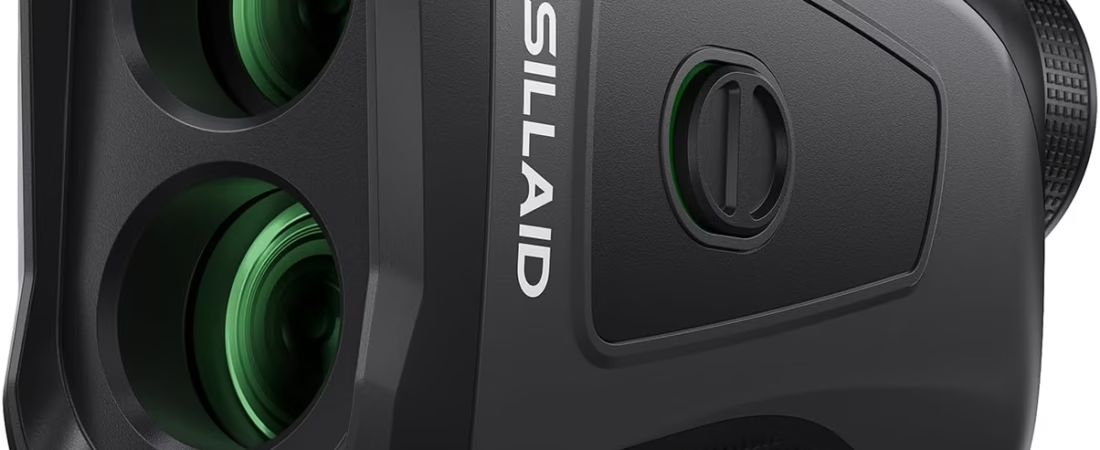
The Golf Range Finder with Slope, 1200 Yards Range Finder Golf with Pin Lock Vibration is designed around this type of target-specific measurement. The Amazon listing identifies several features intended for golf use, including a stated 1,200-yard range, slope functionality, pin-lock vibration, 7X magnification, magnetic attachment, USB-C rechargeable operation, and an IP54 water- and dust-resistance rating.
These features address several different needs. Magnification can help with target identification, pin-lock technology can provide feedback when the flag is acquired, slope information can add context on uphill and downhill shots, and a magnetic design can make the rangefinder easier to access from a golf cart.
At the same time, specifications should be understood in context. A 1,200-yard maximum range does not mean every target can be measured at that distance under all conditions. Slope compensation does not account for wind or the golfer’s personal club distances. A pin-lock system can assist with target acquisition but does not remove the need to aim carefully.
This article explains how this type of golf laser rangefinder works, how its features can be used during a round, and what golfers should consider when deciding whether a laser rangefinder fits their playing style.
Understanding Golf Laser Rangefinders
A laser golf rangefinder is a small optical device that measures the distance between the golfer and a selected target.
The basic process involves several steps.
First, the golfer looks through the optical system and identifies the target. The rangefinder then sends a laser toward the object. When the signal returns, the device calculates the distance and displays the result through the viewing system.
This makes a laser rangefinder different from a fixed course marker.
A yardage marker provides a standardized distance to a particular point. A laser allows the golfer to choose the target.
That target could be:
- A flagstick
- A bunker
- A water hazard
- A tree
- A fairway landing area
- A layup point
- A green-side feature
- Another visible landmark
This flexibility can be especially useful on unfamiliar courses.
A golfer does not necessarily need the distance to the flag on every shot. Sometimes the most useful number is the distance to a hazard or the safe landing area before it.
Key Features of the Golf Range Finder
1,200-Yard Measuring Range
The product is advertised with a maximum measuring range of 1,200 yards.
For most golf shots, the actual measurement will be much shorter than that. The extended range can nevertheless be useful when measuring distant trees, hazards, landmarks, or other objects.
The maximum range should not be confused with the practical range for every possible target.
Laser measurement depends on the characteristics of the object being measured.
A large, reflective object may be easier for a rangefinder to acquire than a thin flagstick surrounded by trees. Bright sunlight, fog, rain, haze, and dust can also affect target visibility and laser performance.
The 1,200-yard specification should therefore be treated as a stated maximum capability under suitable conditions rather than a guarantee that every target will produce a reliable reading at that distance.
7X Magnification
The rangefinder uses 7X magnification.
Magnification can make distant objects appear larger through the optical system, which may help a golfer identify a flag or other target.
This is particularly relevant on longer holes.
A flag at the far end of a large green can be difficult to distinguish from surrounding trees, bunkers, or other background elements with the naked eye. Looking through a magnified optical system can make the target easier to locate.
There is also a practical consideration.
Higher magnification makes movement more noticeable.
If the golfer’s hands move slightly while aiming at a distant flag, that movement can appear much larger through the viewfinder.
A stable grip is therefore important when using a 7X rangefinder.
Pin Lock With Vibration
The pin-lock function is designed to help the rangefinder identify and acquire a flagstick.
Once the target is detected, vibration feedback can provide a physical indication that the pin has been locked.
This is useful because it gives the golfer another confirmation beyond the displayed distance.
For example, a flag may be positioned against a background of trees. Several objects can appear close together through the optical system. Pin-lock technology is intended to help identify the flag rather than simply measuring the nearest background object.
The function should still be treated as an assistance feature.
If the displayed distance appears inconsistent with the layout of the hole, repeating the measurement or changing position can provide additional confirmation.
Slope Measurement
Slope is another important feature for golfers.
A standard laser reading represents the direct distance between the golfer and the target.
On a flat hole, that number can be relatively straightforward to interpret.
An uphill or downhill target is different.
The slope feature can provide additional information about the elevation difference between the golfer and the target. This can help a player understand why a shot may play differently from a level shot with the same direct distance.
Imagine two flags that are both approximately 150 yards away.
One is on level ground.
The other is significantly uphill.
The direct measurement may be similar, but the elevation difference changes the context of the shot.
Slope information provides another data point that the golfer can use when considering club selection.
It is not a complete shot calculator.
Wind, temperature, altitude, lie, ball flight, club characteristics, and the golfer’s normal carry distances remain important.
Slope Switch
A rangefinder designed for golf should provide a practical way to manage slope functionality.
Slope-adjusted information can be restricted in certain competitive situations.
A slope switch allows the golfer to disable the slope feature when required.
However, the phrase “tournament legal” should always be interpreted carefully.
Whether a rangefinder can be used in a particular tournament depends on the applicable rules and local competition conditions.
Golfers should verify the requirements of their specific event before playing.
Magnetic Design
The rangefinder is advertised with a magnetic design.
This can be particularly useful for golfers using a cart.
Instead of keeping the device in a pocket or repeatedly opening a golf bag, the golfer can attach it to an appropriate metal surface on the cart.
Easy access can make the measurement process more convenient during a round.
However, the magnetic attachment should not be treated as completely fail-proof.
The strength of a magnetic connection depends on the surface and conditions. Golfers should make sure the rangefinder is attached securely and remove it when transporting the cart over rough terrain if necessary.
USB-C Rechargeable Operation
The rangefinder uses USB-C rechargeable power.
USB-C has become common across many electronics, which can make charging convenient for golfers who already carry compatible cables and power sources.
Rechargeable operation also means there is no need to continually replace disposable batteries during ordinary use.
The main consideration is battery planning.
A golfer should check the charge before leaving for the course. A depleted rangefinder is of little practical value during a round.
For golfers who travel frequently, a compatible power bank can provide another charging option when access to an electrical outlet is limited.
IP54 Water and Dust Resistance
The product is advertised with an IP54 rating.
An IP54 rating indicates protection against dust at a specified level and against water splashing from various directions.
It is important not to interpret IP54 as full waterproofing.
The rangefinder should not be submerged, placed in standing water, or intentionally exposed to conditions beyond its specified protection.
Rain can also affect target visibility even if the device itself remains protected from ordinary splashes.
The difference between device protection and measurement performance is important. A rangefinder may remain operational in light rain while the rain itself makes a distant flag harder to see.
How It Can Be Used on the Golf Course
Measuring the Flag
The most common use is measuring the flagstick.
The golfer looks through the optical system, identifies the flag, activates the measurement, and uses the pin-lock vibration as additional confirmation when available.
The resulting number can then be compared with personal club distances.
For example, a player who knows their normal carry distances can use the measured yardage to narrow down potential clubs.
The rangefinder provides the measurement.
The golfer makes the decision.
Measuring Bunkers
A bunker can be a more important target than the flag.
From the tee or fairway, a golfer may want to know how far it is to a bunker before choosing a club.
The laser can be aimed at a visible point on or around the bunker.
This allows the player to consider whether the intended club has enough carry distance to clear the hazard or whether a different strategy makes more sense.
Measuring Water Hazards
Water presents another situation where target-specific measurement can help.
A golfer can measure a visible edge or another reference point and compare the distance with their normal carry capability.
The rangefinder does not determine whether a player should attempt the shot.
It simply gives the player more information.
Planning Layup Shots
Long golf holes often involve strategic decisions.
Instead of trying to reach the green immediately, a golfer may want to position the ball at a comfortable distance for the next shot.
A laser rangefinder can help identify suitable landing areas and measure hazards along the way.
This can make the device useful for course management rather than simply for approach shots.
Measuring Trees
Trees can serve as useful reference points.
A golfer might want to know how far away a tree is before deciding whether to play over it, around it, or lay up.
The ability to measure a specific visible object is one of the major advantages of a laser rangefinder over a fixed yardage marker.
Measuring Elevation Changes
Slope becomes especially relevant on hilly courses.
An uphill green may require different planning from a level green at the same direct distance.
Likewise, a downhill shot can behave differently.
The slope function gives the golfer additional information about the elevation difference.
A Step-by-Step Rangefinder Routine
Using a laser rangefinder effectively can become a simple part of a pre-shot routine.
Step 1: Decide What You Need to Know
Start with the actual decision.
Do you need the distance to the flag?
The front of a bunker?
A water hazard?
A layup area?
A tree?
Once the decision is clear, choose the appropriate target.
Step 2: Locate the Target
Look through the rangefinder and use the 7X magnification to identify the object.
Do not rush this step.
Target identification is particularly important when several objects appear close together.
Step 3: Stabilize the Device
Hold the rangefinder securely.
A two-handed grip can help reduce movement.
Higher magnification makes stability more important.
Step 4: Measure
Aim at the selected target and activate the laser.
If the pin-lock function provides vibration feedback, use that as one indication that the flag has been acquired.
Step 5: Review Slope Information
If slope mode is active, consider the elevation difference.
Ask whether the shot is uphill, downhill, or relatively level.
Step 6: Compare With Personal Distances
A measured yardage only becomes useful when the golfer understands what it means for their own game.
Use your normal carry distances rather than relying solely on general club-distance charts.
Step 7: Consider the Conditions
Before choosing the shot, account for:
- Wind
- Temperature
- Lie
- Elevation
- Ball position
- Green shape
- Hazards
- Desired landing area
Step 8: Make the Decision
The rangefinder provides information.
The golfer remains responsible for deciding what to do with it.
Who May Find This Type of Golf Rangefinder Useful?
Golfers Who Play Unfamiliar Courses
A rangefinder can reduce the need to estimate distances when playing a new course.
Instead of relying entirely on memory or course markers, the golfer can measure visible targets directly.
Golfers Who Prefer Laser Technology
Some players prefer a dedicated optical device over smartphone applications.
A laser rangefinder provides a direct workflow that does not require navigating a phone screen.
Golfers Playing Hilly Courses
Slope information can be particularly relevant for golfers who frequently play courses with elevation changes.
Golfers Interested in Course Management
Players who plan around hazards and landing areas can use the rangefinder to collect information about multiple targets rather than simply measuring the flag.
Golf Cart Users
The magnetic design can make the rangefinder easier to access during a cart round.
Instead of searching through a golf bag before every shot, the device can be attached to a suitable metal surface.
Important Things to Consider
Maximum Range Is Not the Same as Target Acquisition Range
A 1,200-yard specification can be useful for understanding the overall capability of the device.
However, a golfer should not expect every target at 1,200 yards to be equally easy to measure.
Target size, reflectivity, color, background, and weather can all influence the result.
A flagstick is a relatively small target.
A large building or tree is much easier to detect.
Higher Magnification Requires Better Stability
7X magnification can help identify distant objects, but it also magnifies movement.
If the image appears to jump around while aiming, try supporting the rangefinder more securely.
Slope Is Not a Substitute for Experience
Slope information is useful, but it is only one part of shot planning.
A rangefinder cannot know whether the golfer is hitting a full 7-iron, a controlled 7-iron, or a punch shot.
It also does not know the exact wind conditions affecting the ball.
Personal distance data remains essential.
Pin Lock Does Not Eliminate Target Identification
A pin-lock function can help confirm a target, but golfers should still pay attention to what the rangefinder is pointing at.
If a measurement seems unreasonable, repeat it.
Changing the viewing angle can also help separate the flag from background objects.
Tournament Rules Need to Be Verified
A product listing may describe a rangefinder as tournament legal, but the actual rules of the event determine what functions are permitted.
Slope compensation is one of the most important areas to check.
Golfers should verify the applicable competition rules and disable restricted functions when necessary.
IP54 Is Not Submersion Protection
The IP54 rating provides a degree of protection against dust and splashing water.
It does not mean the device can safely be submerged.
Users should avoid leaving the rangefinder exposed to heavy rain for long periods and should store it appropriately when not in use.
Battery Management Is Important
Rechargeable equipment requires planning.
Charging the rangefinder the night before a round is a simple habit that can prevent problems.
For travel, consider carrying a suitable charging cable and compatible power source.
Understanding Distance, Carry Distance, and Playing Distance
These three concepts are worth separating.
Measured distance is the distance between the rangefinder and the target.
Carry distance is how far the golf ball travels through the air before landing.
Playing distance is a broader concept that considers how conditions and elevation affect the shot.
A rangefinder primarily provides measured distance.
Slope functionality adds information related to elevation.
The golfer still needs to combine these numbers with their personal carry distances and the current conditions.
For example, if a target measures 150 yards but the golfer’s 7-iron normally carries only 140 yards, the rangefinder has provided useful information. It has not told the golfer to use a 6-iron, because other factors still need consideration.
This is why knowing personal club distances is just as important as having precise yardage information.
Rangefinder vs. GPS Golf Device
GPS golf devices use mapped course data to provide information about the hole.
Depending on the device, they may display:
- Front of green
- Center of green
- Back of green
- Hazards
- Fairway layout
- Green shape
- Other mapped features
A laser rangefinder works differently.
It measures the physical target that the golfer points toward.
GPS has an advantage when the target is hidden or when the golfer wants a broad overview of the hole.
Laser measurement has an advantage when the golfer wants a specific distance to a visible object.
For example, a GPS device may show the distance to the center of the green while a laser can measure the visible flag.
Neither approach has to replace the other.
Rangefinder vs. Smartphone Golf Apps
Smartphone golf apps can provide GPS information, scorekeeping, statistics, maps, weather, and other functions.
Their versatility is their main advantage.
A dedicated rangefinder has a much narrower purpose.
Its workflow is generally straightforward:
Look through the optics.
Aim at the target.
Measure.
Read the result.
For golfers who prefer dedicated equipment, this can be convenient.
For golfers who want a complete digital course-management platform, a smartphone application may provide broader functionality.
Rangefinder vs. Golf GPS Watch
A GPS golf watch can provide information from the wrist and reduce the need to carry a separate handheld device.
A laser rangefinder, however, provides direct optical targeting and can measure a specific visible object.
The choice depends on the golfer’s preferred workflow.
A watch may be useful for quick reference.
A laser can be useful when a precise target-specific measurement is needed.
Rangefinder vs. Traditional Yardage Markers
Traditional yardage markers remain valuable because they are simple and require no battery.
They provide standardized reference points.
A laser rangefinder offers more flexibility because the golfer can choose the target.
The two methods can work together.
A golfer might use the marker to understand the general distance and the rangefinder to measure the exact flag or a specific hazard.
Improving Measurement Reliability
Keep the Lens Clean
Optical clarity matters.
Dust and fingerprints can make targets harder to identify.
Use an appropriate lens cloth and avoid abrasive materials.
Use a Stable Grip
Higher magnification makes movement more visible.
A two-handed grip can help.
Choose a Clear Target
Whenever possible, select a target that is clearly visible and separated from background objects.
Repeat Unexpected Readings
If a measurement does not make sense, take it again.
Multiple consistent readings are more useful than blindly accepting a single unexpected number.
Move if Necessary
Sometimes the problem is the angle.
Moving a few feet can provide a clearer line of sight to the flag or hazard.
Keep Your Own Distance Data
Record your approximate carry distances for your clubs.
This allows the rangefinder’s measurements to become actionable information.
Using the Rangefinder During Practice
A rangefinder does not have to be limited to actual rounds.
It can also be useful during practice sessions.
For example, a golfer can measure distances to targets on a practice area and compare those measurements with their shot data.
This can help create a clearer understanding of how different clubs perform at different distances.
Practice can also help the golfer become familiar with the rangefinder itself.
Learning how to:
- Find a target quickly
- Stabilize the device
- Lock onto a flag
- Switch slope mode
- Interpret the display
- Measure hazards
can reduce unnecessary delays during a round.
Care and Storage
A golf rangefinder is exposed to outdoor conditions, movement, dust, and occasional moisture.
Basic care can help preserve the device.
When not in use, store it in a protective case or another suitable location.
Avoid leaving it loose under heavy objects in a golf bag.
Do not place it in standing water.
If it becomes wet, allow it to dry appropriately and follow the manufacturer’s care instructions.
Keep the optical surfaces clean.
Check the USB-C port periodically for dust or debris, especially if the device is regularly used outdoors.
The rechargeable battery should also be maintained according to the manufacturer’s recommendations.
Frequently Asked Questions
What is the maximum range of this golf rangefinder?
The product is advertised with a maximum measuring range of 1,200 yards.
The practical range for a particular target can vary depending on target size, reflectivity, weather, visibility, and other conditions.
Does it have 7X magnification?
Yes. The product is advertised with 7X magnification.
This can help make distant targets easier to identify through the optical system.
What is pin lock vibration?
Pin lock vibration is a feedback feature intended to indicate that the rangefinder has acquired the flag or pin.
The vibration gives the golfer a tactile confirmation in addition to the displayed distance.
Does it have slope?
Yes. The product is marketed with slope functionality.
Slope information can provide additional context when the target is uphill or downhill.
Can the slope function be turned off?
The product is described as having a slope function and is marketed for tournament use.
The exact process for disabling slope should be confirmed in the user instructions supplied with the specific unit.
Why would I turn slope off?
Some golf competitions restrict slope-adjusted distance information.
Turning slope off allows a golfer to use conventional distance measurement when required by the rules.
Always verify the rules of the specific tournament.
Is it waterproof?
The product is advertised with IP54 water and dust resistance.
IP54 is not the same as full waterproofing or submersion protection.
The rangefinder should not be intentionally submerged.
Can it be used in rain?
The IP54 rating provides some protection against splashing water.
However, rain can also make distant targets harder to see and may affect measurement conditions.
Is it rechargeable?
Yes. The product is advertised as a USB-C rechargeable golf rangefinder.
Checking the battery before a round is recommended.
Does it have a magnetic mount?
Yes. The product is advertised as a magnetic golf rangefinder.
The magnetic feature is intended to provide convenient attachment to a suitable metal surface, such as a compatible golf cart location.
Can I measure trees and bunkers?
Yes. A laser rangefinder can be used to measure visible objects beyond the flag, including trees, bunkers, hazards, and other landmarks.
Can I use it for layup planning?
Yes. Measuring a fairway hazard or landing area can help a golfer plan a layup.
The golfer can use the measured distance alongside personal club distances and course conditions.
Does slope tell me exactly how far my shot will travel?
No.
Slope provides information about elevation and adjusted distance, but it does not account for every factor influencing ball flight.
Wind, temperature, lie, club selection, ball characteristics, and the golfer’s swing all matter.
Can it replace a GPS golf device?
Not necessarily.
GPS devices provide mapped course information, while laser rangefinders measure visible targets.
They have different strengths and can also be used together.
Can it replace course yardage markers?
It does not need to replace them.
Traditional markers provide standardized information without requiring batteries.
A laser can provide additional target-specific measurements.
Is 7X magnification always better?
Not automatically.
Higher magnification can make distant targets easier to see, but it also makes hand movement more noticeable.
What should I do if the flag does not lock?
Stabilize the rangefinder, check the target alignment, and try again.
If the flag is surrounded by trees or other objects, changing your position slightly may provide a clearer line of sight.
Can the rangefinder measure a hazard?
If the hazard or an appropriate reference point is visible, a laser rangefinder can generally be aimed at it for distance measurement.
Does weather affect laser measurement?
Yes.
Fog, rain, haze, dust, glare, and poor visibility can make target acquisition more difficult.
How important is personal club distance?
Very important.
The rangefinder tells you the distance to the target. Your own carry-distance information helps you understand what that distance means for your shot.
Can beginners use a laser rangefinder?
Yes.
It can help beginners become more familiar with actual distances on a course.
However, learning club distances and basic course management remains important.
Is a golf rangefinder useful for practice?
Yes.
It can be used to measure practice targets and help golfers compare their actual shot distances with specific yardages.
Does the magnetic mount work everywhere?
The magnetic feature is intended for suitable metal surfaces.
The strength and stability of the attachment depend on the surface and conditions, so users should make sure the device is securely positioned.
Conclusion
The Golf Range Finder with Slope, 1200 Yards Range Finder Golf with Pin Lock Vibration is designed to provide golfers with direct, target-specific distance measurements while adding several features intended to make course use more convenient.
Its advertised specifications include a 1,200-yard maximum range, 7X magnification, pin-lock vibration, slope functionality, magnetic attachment, USB-C rechargeable operation, and IP54 water and dust resistance.
These features address different aspects of golf distance measurement.
The 7X optical magnification can help golfers identify distant targets. Pin-lock vibration provides additional feedback when acquiring the flag. Slope information can help interpret uphill and downhill shots. The magnetic design can keep the device accessible when using a golf cart, while USB-C charging provides a convenient way to replenish the battery.
The most important consideration is how the information is used.
A rangefinder can measure the distance to a flag, bunker, tree, water hazard, or layup area, but it cannot make the complete shot decision for the golfer. Personal carry distances, wind, temperature, lie, elevation, course strategy, and the consequences of a missed shot all remain relevant.
The 1,200-yard specification should also be viewed as a maximum capability rather than a promise that every target will be measured equally well at that distance. Target characteristics and environmental conditions can affect laser acquisition.
Similarly, slope functionality should be treated as additional information rather than a guaranteed prediction of ball flight. Golfers participating in competitions should verify the rules that apply to their event and make sure any restricted functions are disabled when necessary.
For golfers who prefer direct laser measurement and want a combination of optical magnification, pin-lock feedback, slope information, magnetic cart attachment, rechargeable power, and outdoor-oriented protection, this type of rangefinder provides a practical set of tools for everyday course management.
Used thoughtfully, a laser rangefinder can become part of a consistent pre-shot routine: identify the target, measure the distance, consider elevation and conditions, compare the result with personal club data, and then make the shot decision.