Introduction
Distance management is one of the most practical parts of playing golf. Knowing how far it is to the flag, a bunker, a water hazard, or another point on the course can help a golfer make a more informed club-selection decision. While course markers and sprinkler-head yardages provide useful information, a laser rangefinder can add another layer of detail by measuring the distance to a specific target.
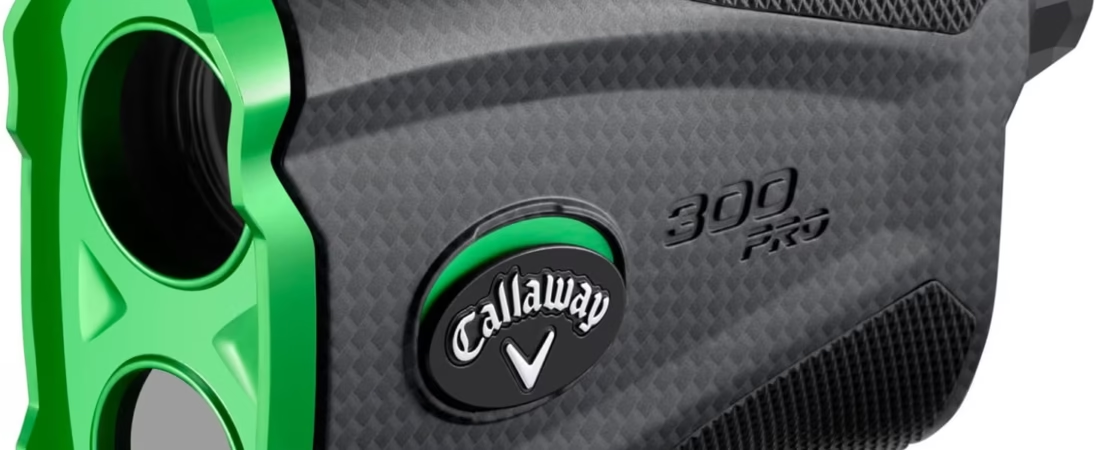
The Callaway 300 Pro Golf Laser Rangefinder – Elyte is a compact laser rangefinder designed for golfers who want direct distance measurements while playing. Callaway’s published specifications for the 300 Pro identify a 5- to 1,000-yard measuring range, 6X magnification, Pin Acquisition Technology with Pulse Technology, slope measurement, scan functionality, yard-or-meter readings, and an integrated Magnahold magnet. The manufacturer also lists an accuracy specification of plus or minus one yard and describes the unit as water and fog proof.
The product name used in the Amazon listing includes “Elyte.” However, Callaway’s current official product information identifies the underlying device as the 300 Pro Laser Rangefinder, so the most useful way to understand the product is through the documented features of the 300 Pro rather than assuming that the “Elyte” designation represents a completely different rangefinder.
A laser rangefinder is not a replacement for course knowledge, shot planning, or club-selection experience. Instead, it is a measurement tool. The golfer still needs to interpret the number, account for conditions, choose an appropriate target, and execute the shot.
This guide explains how the Callaway 300 Pro works, what its features mean in practical terms, how slope measurement can affect yardage decisions, and what golfers should consider when deciding whether this type of rangefinder fits their playing style.
Understanding What a Golf Laser Rangefinder Does
A laser rangefinder works by sending a laser toward a target and measuring the return signal to calculate distance. Instead of relying only on fixed yardage markers, the golfer can point the device toward a specific object and receive a distance reading.
On a golf course, that object might be:
- A flagstick
- A bunker
- A tree
- A water hazard
- A fairway landing area
- A layup point
- A greenside feature
- Another visible landmark
The usefulness of this approach comes from choosing the right target.
For example, if a golfer wants to know the distance to a bunker rather than the flag, the rangefinder can be aimed at the bunker. Similarly, a player planning a layup can measure a point in the fairway instead of automatically measuring the green.
That makes a rangefinder more than a simple flag-measuring device. It can become part of a broader course-management process.
Key Features of the Callaway 300 Pro
6X Magnification
Callaway specifies 6X magnification for the 300 Pro.
Magnification enlarges the visual field through the rangefinder, making it easier to identify a distant target through the optical system.
This can be particularly useful when the flag is relatively small in the golfer’s field of view or when several potential targets are positioned close together.
Magnification does not mean that every target becomes equally easy to measure. Trees, background objects, moving targets, atmospheric conditions, and the golfer’s ability to hold the rangefinder steady can all affect the process.
The 6X specification is therefore best understood as part of the optical system rather than as a guarantee of a particular measurement experience.
5- to 1,000-Yard Measuring Range
The manufacturer’s specifications list a range from 5 to 1,000 yards.
This broad measurement range allows the device to be used for many different targets on a golf course.
Short-distance measurements can be useful around the green or when checking the distance to a nearby obstacle. Longer measurements can be used for distant trees, hazards, fairway targets, and other landmarks.
It is worth remembering that the maximum published range does not mean every target will be equally easy to acquire at the maximum distance.
Target size, color, surface characteristics, visibility, lighting, atmospheric conditions, and how steadily the device is held can influence laser acquisition.
Slope Technology
Slope measurement is one of the more significant features of the 300 Pro.
According to Callaway, the rangefinder measures the angle of incline or decline and calculates a slope-adjusted distance.
This addresses a common problem in golf: two shots can have the same straight-line distance but require different considerations when one target is significantly uphill or downhill.
For example, imagine a flag that appears to be 150 yards away on a steeply uphill green. The physical distance measured by the laser and the playing distance may not be identical in practical terms.
Slope technology attempts to provide additional information by considering elevation change.
The feature should not be interpreted as a guarantee that the resulting number is the exact distance a golfer must play. Club selection also depends on factors such as wind, temperature, lie, ball flight, altitude, and the golfer’s own shot characteristics.
Instead, slope-adjusted distance can serve as another piece of information.
External Slope On/Off Switch
Callaway states that the slope function can be disabled using an external switch, and identifies this configuration as allowing the rangefinder to be used in tournament play when slope compensation is not permitted.
This distinction is important because golfers should not assume that every electronic feature is automatically permitted in every competition.
Rules can depend on the competition and applicable governing rules. Before using a rangefinder in a tournament, players should verify the current rules and the event’s local requirements.
The external control is useful because it makes the slope status easier to manage without requiring a complicated menu procedure.
P.A.T. Pin Acquisition Technology
The 300 Pro incorporates Callaway’s P.A.T., or Pin Acquisition Technology. The system is designed to help identify and lock onto the flagstick. Callaway combines P.A.T. with Pulse Technology, which provides a short vibration when the pin is acquired.
This can be useful when the golfer is aiming toward a green where multiple objects are visible.
A flag may be surrounded by trees, bunkers, vegetation, or other background objects. A confirmation signal can provide additional feedback that the intended target has been detected.
The vibration is particularly useful because the golfer does not need to rely exclusively on watching the display while holding the rangefinder.
It is still important to aim carefully. Target acquisition technology assists with the process, but it does not eliminate the need for proper alignment.
Scan Function
Callaway also specifies the ability to scan the landscape and acquire multiple targets.
This can be useful for course management rather than simply measuring the flag.
Suppose a golfer is standing on a tee and wants to understand the hole before choosing a strategy. Measuring several visible landmarks can provide additional information:
- Distance to a fairway bunker
- Distance to a tree
- Distance to a hazard
- Distance to a preferred landing area
- Distance to the green
The ability to examine several targets can therefore support planning before the shot rather than being limited to final approach distance.
How the Rangefinder Can Be Used on the Course
Measuring the Flag
The most obvious application is measuring the flagstick.
A golfer can look through the rangefinder, identify the flag, and activate the measurement. P.A.T. and Pulse Technology are designed to help confirm when the pin has been acquired.
The resulting number can then be considered alongside the golfer’s club distances and current playing conditions.
Measuring Hazards
A golfer does not always need the distance to the hole.
Sometimes the most useful number is the distance to a hazard.
For example, measuring the front edge of a water hazard can help a player determine whether a particular club could reach it. Measuring a bunker can similarly help with deciding whether to carry it or lay up short.
This can be particularly useful on unfamiliar courses where fixed yardage markers may not provide every distance a player wants.
Planning Layup Shots
Not every hole calls for a direct attack at the green.
A player may choose to position the ball at a particular distance for the next shot. A laser rangefinder can help identify a suitable landing area by measuring visible landmarks or points on the fairway.
This can make the device useful for golfers who think about the course in terms of positioning rather than simply maximum distance.
Measuring Trees and Other Reference Points
Trees can serve as useful reference points.
A golfer might want to know the distance to a tree that blocks part of the fairway, or measure a tree near the green to understand whether a certain shot shape is realistic.
The same principle applies to visible buildings, bunkers, mounds, or other stable objects.
Understanding Uphill and Downhill Shots
Elevation changes are where slope technology becomes particularly relevant.
When the target is significantly above or below the golfer, a straight-line measurement may not fully communicate how the shot should be approached.
The slope function can provide a slope-adjusted distance based on the measured angle.
However, golfers should avoid treating the adjusted figure as an automatic club recommendation. It is better viewed as information that can be combined with personal shot data and course conditions.
Why Distance Measurement Matters in Golf
Distance information can influence several decisions during a round.
A golfer typically considers:
- Where the target is
- How far away it is
- What club can cover the required distance
- Whether hazards affect the shot
- How elevation changes the situation
- How wind affects the ball
- What miss is acceptable
- Where the next shot should ideally begin
A rangefinder addresses primarily the measurement component.
The other decisions remain with the golfer.
This distinction is important because technology can provide more precise information without automatically producing better decisions. A player still needs to understand their own club distances and recognize the conditions on the course.
Who May Find This Type of Rangefinder Useful?
Golfers Who Play Unfamiliar Courses
A rangefinder can be particularly practical on courses that the golfer does not know well.
Instead of relying entirely on memory or general course markers, the player can measure specific targets during the round.
Golfers Learning Their Distances
Newer golfers may still be developing consistent distances with each club.
A rangefinder does not measure how far the golfer will hit the ball, but it can provide a precise target distance that can be compared with the player’s known capabilities.
Over time, this can help players understand how their normal club distances relate to actual course situations.
Experienced Golfers Who Prefer Laser Measurements
Some golfers prefer the direct targeting approach of a laser rather than relying exclusively on GPS-based yardage.
A laser can be aimed at a specific visible object, which can be useful when the player wants a distance to something that is not represented as a standard GPS point.
Golfers Who Play Hilly Courses
The slope feature may be particularly relevant for courses with substantial elevation changes.
Instead of seeing only a straight-line distance, the golfer can use slope information to understand how the elevation difference changes the measurement.
Golfers Interested in Course Management
Players who think carefully about hazards, landing areas, and layup positions can use the rangefinder to collect more information than simply the distance to the flag.
Important Things to Consider
A Rangefinder Does Not Measure Your Personal Club Distance
The device measures the distance to a target.
It does not know how far a specific golfer will hit a 7-iron, 5-wood, driver, or wedge.
For meaningful club selection, the player needs to understand their own typical distances.
A golfer who knows that their normal 7-iron carries approximately a particular distance can compare that knowledge with the measured target distance.
Slope Does Not Account for Every Playing Condition
Slope technology considers elevation changes, but golf shots are affected by more than elevation.
Wind can have a substantial effect. Temperature and altitude can also influence ball flight. The lie of the ball, turf conditions, humidity, swing quality, and ball characteristics can also matter.
Therefore, slope-adjusted distance should be treated as useful information rather than a complete shot prediction.
Accuracy Specifications Are Not the Same as Guaranteed Real-World Results
Callaway lists accuracy of plus or minus one yard for the 300 Pro.
That specification describes the manufacturer’s stated accuracy under its applicable conditions.
Real-world measurement can still be influenced by the target, visibility, stability, atmospheric conditions, and how the device is used.
Target Selection Matters
A laser rangefinder can measure whatever object it successfully acquires.
That means the golfer must identify the intended target correctly.
When several objects are close together, it is worth confirming that the measured distance corresponds to the object the golfer intended to measure.
Slope Mode Should Be Managed Carefully in Competition
Because slope-adjusted information can be restricted under certain rules, golfers should know whether the slope function needs to be disabled.
Callaway specifically provides an external slope on/off control for this purpose.
Players participating in organized events should always confirm the applicable rules instead of relying solely on a manufacturer’s description.
Weather and Visibility Still Matter
Callaway describes the 300 Pro as water and fog proof.
That does not mean visibility becomes irrelevant.
Fog, heavy rain, low light, glare, and other environmental conditions can make targets more difficult to see or acquire.
Weather resistance protects the device under the conditions covered by its design, but it does not eliminate the optical challenges created by poor visibility.
Rangefinder vs. GPS Golf Device
Laser rangefinders and GPS golf devices approach distance measurement differently.
A GPS device can provide information based on the course layout and mapped points. This can be useful when the golfer wants distances to greens, hazards, and other predefined locations.
A laser rangefinder instead measures a physical target that the golfer can see.
That makes the two technologies useful in different situations.
A GPS device can be convenient when the target is not easily visible. A laser can be useful when the golfer wants the distance to a particular tree, bunker edge, flagstick, or other visible object.
Some golfers may prefer one system, while others may use both.
Rangefinder vs. Golf Course Yardage Markers
Traditional yardage markers remain useful because they require no battery or electronic equipment.
Markers may provide distances to the center of the green or another standardized reference point.
A rangefinder provides more target-specific information.
For example, a course marker might tell a player the distance to the middle of the green, while the rangefinder can potentially measure the visible flag.
The two methods can complement each other.
Rangefinder vs. Smartphone Apps
Golf applications can provide maps, GPS distances, scorekeeping, statistics, and other information.
A smartphone is also a multifunction device that many golfers already carry.
A dedicated laser rangefinder has a different workflow. The golfer picks it up, looks through the optical system, aims, and obtains a distance.
For someone who prefers quick physical target measurement without navigating a phone interface, this can be a useful distinction.
On the other hand, golfers who want maps, hole layouts, score tracking, and broader course information may find smartphone or GPS systems more comprehensive.
Practical Tips for Using the Callaway 300 Pro
Start by Identifying the Target
Before pressing the measurement button, decide what you actually want to measure.
Is it the flag?
The front of a bunker?
The far edge of a hazard?
A tree?
A layup point?
Knowing the target first makes the measurement more useful.
Hold the Unit Steadily
A laser rangefinder requires accurate alignment.
Use both hands if that helps maintain stability, especially when measuring distant targets.
The 6X optical magnification also means that small movements can become noticeable through the viewfinder.
Use Scan Mode for Course Planning
When standing on the tee or fairway, scan multiple visible landmarks if you need more information.
This can provide a broader understanding of the hole rather than focusing only on the flag.
Compare the Measurement With Your Own Data
Once the distance is known, consider it alongside your personal club distances.
For example, if the rangefinder shows a target at a distance that sits between two clubs, the decision should consider carry distances, wind, elevation, lie, and the consequences of missing.
Use Slope Information as One Input
On hilly terrain, slope can add useful context.
But it should be combined with experience rather than treated as an automatic answer.
Keep the Optics Clean
Dirt, fingerprints, and moisture can interfere with visibility.
A clean optical surface makes it easier to identify and aim at distant targets.
Golf Rangefinder and Course-Management Strategy
One of the most interesting ways to use a laser rangefinder is to think about it as a course-management tool rather than merely a flag finder.
Consider a par 5 with a bunker positioned on the right side of the fairway.
A golfer could measure the bunker, estimate the carry distance, and compare that number with the normal distance of the club being considered.
The player could then decide whether the risk is acceptable.
On another hole, a golfer might measure a safe landing area rather than aiming directly at the green.
The rangefinder provides the measurement. The strategy remains a human decision.
This distinction can help prevent overreliance on technology. More information is valuable when it supports a clear decision-making process.
Maintenance and Storage
Like any optical electronic device, a rangefinder should be treated carefully.
Avoid placing it where it can be crushed under heavy equipment in a golf bag. When possible, protect the optical surfaces from scratches and unnecessary dirt.
If the device becomes wet, follow the manufacturer’s care instructions rather than assuming that its weather resistance makes every form of exposure harmless.
Battery management is also worth considering. A rangefinder that has not been used for a long time should be checked before heading to the course.
Keeping the device accessible can also make it easier to use efficiently. The integrated Magnahold feature is designed to attach the unit to a golf cart frame for quick access during play.
Frequently Asked Questions
What is the maximum range of the Callaway 300 Pro?
Callaway lists a measuring range of 5 to 1,000 yards for the 300 Pro.
The practical ability to acquire a particular target can vary according to target characteristics, visibility, weather, and other conditions.
Does the Callaway 300 Pro have slope?
Yes. Callaway specifies slope technology that measures incline or decline and calculates a slope-adjusted distance.
The slope function can be switched off using the external control.
Can slope be turned off for tournament play?
The 300 Pro includes an external slope on/off switch, and Callaway identifies the rangefinder as legal for tournament play when the slope feature is disabled.
Golfers should still check the rules of the specific competition they are playing.
What magnification does it use?
The published specification lists 6X magnification.
Can it measure distances in meters?
Yes. Callaway specifies measurement in both yards and meters.
What is Pin Acquisition Technology?
P.A.T., or Pin Acquisition Technology, is designed to help the rangefinder identify and lock onto the flagstick. The 300 Pro combines this function with Pulse Technology, which provides a short vibration when the pin is acquired.
What is Pulse Technology?
Pulse Technology provides tactile feedback through a short vibration when the rangefinder detects the pin. This can give the golfer another indication that the intended target has been acquired.
Can it measure trees and bunkers?
Yes. A laser rangefinder can be used to measure visible targets such as trees, bunkers, hazards, and other landmarks. Callaway also specifies a scan function for acquiring multiple targets.
Is the rangefinder water resistant?
Callaway describes the 300 Pro as water and fog proof.
Users should nevertheless follow the manufacturer’s care instructions and avoid unnecessary exposure to water.
How much does the 300 Pro weigh?
Callaway lists the weight as 5.4 ounces.
Its published dimensions are 4 inches by 2.7 inches by 1.4 inches.
Does it have a magnet?
Yes. The 300 Pro incorporates Callaway’s Magnahold integrated magnet, designed to secure the rangefinder to a golf cart frame for convenient access.
Is a laser rangefinder useful for beginners?
It can be. Beginners may use a rangefinder to become more familiar with actual distances on the course.
However, new golfers should remember that knowing the exact distance does not automatically determine the correct club. Learning personal carry distances and understanding basic course management remain important.
Can a rangefinder improve club selection?
It can provide more precise distance information, which may help inform club selection.
The final decision still depends on the golfer’s personal club distances, elevation, wind, lie, desired landing area, and other conditions.
Does slope tell me exactly which club to use?
No. Slope-adjusted distance is additional information rather than a guaranteed club recommendation.
The golfer still needs to interpret the measurement and account for playing conditions.
Can the rangefinder replace a GPS golf device?
Not necessarily.
A laser measures visible targets, while GPS devices can provide mapped course information even when a target is difficult to see. Each approach has different advantages.
What should I do if the rangefinder locks onto the wrong target?
Reposition the device, identify the intended target carefully, and measure again.
When multiple objects are close together, target identification is especially important.
Conclusion
The Callaway 300 Pro Golf Laser Rangefinder – Elyte is a compact distance-measurement tool designed around the needs of golfers who want direct measurements to visible targets. Callaway’s documented specifications include 6X magnification, a 5- to 1,000-yard range, slope technology, P.A.T. with Pulse Technology, scan functionality, yard-and-meter measurement, an integrated Magnahold magnet, and a stated accuracy of plus or minus one yard.
Its usefulness extends beyond measuring the flag. Golfers can use a laser rangefinder to examine hazards, bunkers, trees, landing areas, layup positions, and other landmarks around the course. The scan function can support broader course planning, while slope measurement can provide additional information on uphill and downhill shots.
At the same time, the rangefinder should be viewed as a measurement aid rather than an automatic shot-planning system. The golfer still needs to understand personal club distances, account for wind and course conditions, select appropriate targets, and interpret the distance in context.
The external slope control is another practical consideration for golfers who participate in competitions where slope-adjusted information is restricted. Callaway specifically designed the 300 Pro so that the slope function can be disabled.
Ultimately, the value of a laser rangefinder comes from how the information is incorporated into the golfer’s existing decision-making process. A precise distance can make a decision more informed, but good course management still depends on judgment, experience, and an understanding of one’s own game.
For golfers researching a compact laser rangefinder with slope measurement, pin-acquisition feedback, optical magnification, and a broad stated measuring range, the Callaway 300 Pro provides a set of features designed around straightforward on-course distance measurement.