Introduction
Accurate distance information can be useful in many outdoor activities. Whether someone is observing wildlife, navigating a large property, practicing archery, playing golf, or participating in lawful hunting activities, knowing the approximate distance to a visible object can provide valuable context.
A laser rangefinder is designed specifically for this purpose. Instead of estimating distance by eye or relying on a map, the device sends a laser toward a target and calculates the distance based on the returning signal. For outdoor users, this can make measurements more convenient and repeatable.
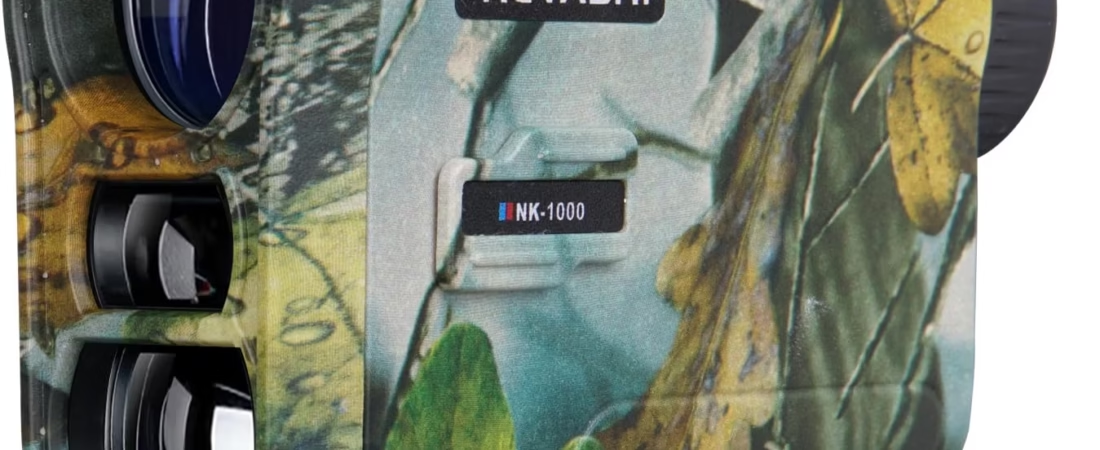
The REVASRI Hunting Laser Rangefinder with Rechargeable Battery is a compact rangefinder marketed for hunting and other outdoor applications. The model associated with the Amazon listing is the REVASRI NK-1000. Its documented specifications include a 5- to 1,000-yard measuring range, 6.5X magnification, manual focusing, an in-view LCD display, a built-in rechargeable lithium-ion battery, USB-C charging, and a Class 1 905 nm laser. The documentation also identifies several measurement modes, including ranging, scanning, speed measurement, two-point height measurement, and golf distance compensation.
The device is therefore more than a basic distance meter. Its different modes allow it to be used for several kinds of measurements, although not every feature is equally relevant to every outdoor activity.
This guide explores how the REVASRI NK-1000 works, what its specifications mean in practical terms, how it can be used responsibly, and what users should consider before relying on a laser rangefinder in outdoor environments.
What Is a Laser Rangefinder?
A laser rangefinder is an optical electronic device that measures distance to a selected target.
The basic process is straightforward:
- The user aims the rangefinder at a visible object.
- The device emits a laser signal.
- The signal reflects from the target.
- The rangefinder calculates the distance.
- The result appears through the internal display.
Unlike a traditional measuring tape, a rangefinder does not need physical contact with the target.
This makes the technology particularly useful outdoors, where the target may be hundreds of yards away.
A laser rangefinder can potentially measure:
- Trees
- Buildings
- Terrain features
- Flags
- Targets at an approved range
- Fairway landmarks
- Archery targets
- Wildlife observation points
- Property boundaries or reference points
- Other suitable visible objects
The quality of the measurement depends on several factors. Target size, reflectivity, weather, distance, visibility, aiming stability, and the line of sight can all influence how easily the device obtains a reading.
Key Features of the REVASRI NK-1000
5- to 1,000-Yard Measuring Range
The NK-1000 is specified for measurements from 5 to 1,000 yards. Its documented distance accuracy is approximately ±1 yard under the manufacturer’s specified conditions.
A 1,000-yard maximum range gives the device considerable flexibility for outdoor distance measurement.
For everyday use, however, the maximum number should not be interpreted as a guarantee that every target at exactly 1,000 yards will be equally easy to acquire.
A large, reflective object can be easier for a laser to detect than a small or poorly contrasted target. Fog, rain, dust, glare, and vegetation can also affect laser transmission.
The practical range of any laser rangefinder therefore depends on the target and environment as well as the headline specification.
6.5X Magnification
The REVASRI NK-1000 uses 6.5X magnification with a 24 mm objective lens according to the available product documentation.
Magnification is useful when the target is far away or relatively small in the user’s field of view.
For example, a distant tree may appear small to the naked eye. Through the rangefinder’s optical system, the object becomes easier to identify and aim at.
Magnification does not automatically improve the measurement itself. It primarily helps the user see and align with the target.
There is also a practical trade-off: greater magnification can make hand movement more noticeable. Holding the rangefinder steadily becomes increasingly important when trying to measure a distant object.
Multilayer-Coated Optics
The available specifications identify multilayer-coated optical lenses.
Lens coatings are used in optical equipment to help manage reflections and improve light transmission.
This matters when using a rangefinder outdoors because sunlight can create glare, while shaded areas can reduce the available light.
Optical clarity is influenced by more than lens coatings, however. Weather, atmospheric haze, lighting, target contrast, and the cleanliness of the lens can all affect what the user sees.
Keeping the optical surfaces clean is therefore an important part of maintaining useful visibility.
In-View LCD Display
The NK-1000 uses an in-view LCD display. Instead of requiring the user to look away at a separate screen, measurement information appears inside the optical viewing area.
This arrangement can make the measurement process straightforward.
The user can look through the eyepiece, identify the target, and read the measurement without shifting attention to a phone or external display.
The display is integrated into the optical system, so proper eyepiece adjustment is important.
If the view appears blurry, the manual recommends adjusting the focusing eyepiece until both the target and display appear sharp.
Manual Focus
The rangefinder uses a manual focusing eyepiece.
This allows the user to adjust the optical view for individual eyesight and viewing conditions.
Manual focus is particularly useful for people who wear glasses because the eyepiece can be adjusted to produce a clearer view.
It also helps accommodate different users. Two people may have different visual requirements, and the ability to adjust the eyepiece can make the device more comfortable to use.
Built-In Rechargeable Battery
The NK-1000 uses a built-in lithium-ion battery and supports USB-C charging.
A rechargeable battery eliminates the need to regularly replace disposable batteries during normal use.
USB-C charging also fits into the charging ecosystem already used by many modern electronics.
Before an outdoor trip, it is sensible to check the battery level. A rangefinder is most useful when it is ready to operate when needed.
Users should also follow the manufacturer’s charging and storage instructions, especially if the device will remain unused for an extended period.
Seven Measurement Modes
One of the more distinctive characteristics of the NK-1000 is its range of measurement modes.
The documentation identifies seven functions:
- Ranging
- All-in-one measurement
- Scanning
- Speed measurement
- Two-point height measurement
- Golf distance compensation
- Storage
The device also has a mode-memory function that can remember the previously selected mode.
These modes make the rangefinder useful beyond a single-purpose hunting application.
The most useful mode depends on what the user is trying to measure.
Standard Ranging Mode
Standard ranging mode measures the straight-line distance to a selected target.
This is the most fundamental function of the device.
For example, a user could measure the distance to a tree, a building, or another stable reference point.
The resulting distance is the direct line-of-sight measurement.
All-in-One Mode
The all-in-one mode can provide several measurements together, including angle, height, horizontal distance, and straight-line distance.
This can be useful when the user needs more context than a simple distance.
For example, a target positioned above or below the user involves an elevation difference. Seeing both distance and angle can provide a better understanding of the geometry involved.
Scanning Mode
Scanning allows multiple targets to be measured continuously rather than requiring the user to make a completely separate measurement for every object.
This can be useful for surveying a landscape.
A user could scan across several visible objects and compare their distances.
Scanning may also be useful for general outdoor measurement where the user wants to understand the relative positions of several landmarks.
Speed Measurement
The NK-1000 includes a speed-measurement mode.
This is a specialized feature rather than something every user will need.
It may be useful for certain moving-target measurement applications or outdoor activities where estimating the speed of an object is relevant.
The accuracy of speed measurement depends on the movement of the target and how the device is used, so it should be treated as an electronic measurement aid rather than a substitute for specialized speed-measurement equipment.
Two-Point Height Measurement
The two-point height function calculates height based on measurements to two points.
This can be useful for estimating the height of a tree, structure, or other object when both relevant points are visible.
For example, a user could measure the lower point and upper point of a tree and use the device’s calculation to estimate its height.
The result depends on accurate targeting and appropriate positioning.
Golf Distance Compensation
Although the product is marketed primarily as a hunting rangefinder, the NK-1000 also includes a golf distance compensation mode.
This demonstrates that the device is designed as a multi-purpose outdoor rangefinder rather than an exclusively hunting-specific instrument.
Golf users can use slope-related information to better understand uphill and downhill distances.
The feature is not necessary for hunting, but it adds versatility for people who participate in more than one outdoor activity.
Storage Mode
The documentation identifies a storage function for previous measurement data.
Having access to stored measurements can be useful when the user wants to refer back to previous readings rather than recording every value manually.
The exact behavior and capacity should be checked against the current user manual.
How It Can Be Used for Outdoor Distance Measurement
Measuring Trees and Terrain
Trees are natural reference points because they are large, stationary objects.
A rangefinder can help determine how far a tree is from the user’s current position.
The same principle can apply to:
- Rock formations
- Buildings
- Hillsides
- Fences
- Towers
- Large signs
- Other stable landmarks
These measurements can help create a better mental picture of a landscape.
Wildlife Observation
A rangefinder can also be useful for wildlife observation.
Knowing the approximate distance to an animal can provide useful context for photography, observation, or field notes.
When observing wildlife, the rangefinder should be used without disturbing the animal. The device is a measurement instrument, not a reason to approach wildlife more closely than is appropriate.
For photographers, knowing distance can also help with lens selection and composition.
Archery Practice
The rangefinder can be used to measure distance to an archery target.
Knowing the exact distance can be particularly useful when practicing at different ranges.
For safe archery use, the rangefinder should be used only as a measurement device, while all normal range-safety procedures remain in place.
Golf
The golf compensation mode provides a separate application.
Golfers can use a rangefinder to measure the distance to visible flags, trees, hazards, and other course features.
The device’s angle and distance information can provide additional context on uphill and downhill shots.
Golfers participating in competitions should verify whether slope compensation is permitted under the applicable rules.
Property and Outdoor Projects
A laser rangefinder can be useful for general outdoor measurement.
For example, someone working on a large property may want approximate distances between visible landmarks.
It can also help during planning for landscaping, outdoor construction, photography locations, or recreational activities.
A rangefinder should not be treated as a replacement for professional surveying equipment when legally or technically precise measurements are required.
Using the Rangefinder Responsibly During Hunting
For lawful hunting activities, a rangefinder can primarily serve as a distance-measurement tool.
Distance information can help hunters understand the landscape and make more informed decisions about whether a particular shot is appropriate.
However, distance is only one consideration.
Responsible hunting also requires understanding local laws, knowing the applicable hunting season and permitted equipment, identifying the intended animal correctly, understanding the environment, and following established safety practices.
The rangefinder does not determine whether a shot is ethical, legal, or safe.
It simply provides a measurement.
This distinction is important because technology can provide precise information without replacing human judgment.
Hunters should also avoid using a rangefinder as a reason to approach animals beyond safe or lawful boundaries.
Target Acquisition and Small Objects
The product listing emphasizes target acquisition technology.
Target acquisition is important because laser rangefinders need a suitable reflection from the object being measured.
A large tree may be relatively easy to acquire.
A small object surrounded by vegetation can be more difficult.
The user’s ability to stabilize the device and aim precisely also matters.
For small targets, the following approach can help:
- Stabilize the rangefinder.
- Use the optical magnification to locate the target.
- Place the aiming point directly on the target.
- Avoid measuring through glass.
- Repeat the measurement if the result appears inconsistent.
- Compare the reading with the surrounding landscape.
The product documentation specifically notes that glass and environmental factors such as rain, fog, strong light, and dust can interfere with ranging.
Who May Find This Rangefinder Useful?
Hunters
The NK-1000 is designed with hunting among its primary applications.
Its combination of long-range measurement, magnification, angle information, scanning, and rechargeable power makes it suitable for users who need portable distance information in outdoor environments.
Archers
Archers can use a rangefinder to measure the distance to a practice target or other suitable reference point.
This can make training sessions more structured because distances can be checked rather than estimated.
Golfers
The golf compensation mode makes the rangefinder useful for golfers who want a multi-purpose device rather than equipment dedicated exclusively to hunting.
Wildlife Observers
Wildlife enthusiasts can use the rangefinder to estimate distances to animals or natural features without physically approaching them.
Outdoor Hobbyists
Hikers, photographers, landowners, and other outdoor users may find a portable distance-measurement tool useful for specific projects.
The device is relatively compact, measuring approximately 96 × 34 × 67 mm according to the published specifications.
Important Things to Consider
The 1,000-Yard Rating Is a Maximum Specification
The advertised measuring range should be understood as a maximum stated capability.
Actual measurement performance can vary.
A reflective target in good visibility may be easier to measure than a dark or small target in fog.
Environmental conditions can significantly affect laser transmission.
Accuracy Depends on Conditions
The documented accuracy is approximately ±1 yard for the NK-1000.
This specification should not be interpreted as meaning every real-world measurement will always be within exactly one yard.
Accuracy can be influenced by:
- Target characteristics
- Atmospheric conditions
- Distance
- User stability
- Target acquisition
- Visibility
- Angle
- Line of sight
For critical measurements, repeating the measurement can provide an additional check.
Angle Accuracy Is a Separate Specification
The device is documented with approximately ±1-degree angle accuracy.
Angle information is useful for understanding elevation differences, but it should not be confused with distance accuracy.
These are separate measurements.
Do Not Measure Through Glass
The manual specifically identifies measuring through glass as a potential cause of measurement problems.
This is worth remembering in practical situations.
A user standing inside a vehicle or building should not assume that the rangefinder will produce a reliable distance through a window.
For accurate outdoor measurements, establish a clear line of sight whenever possible.
Weather Can Affect Measurement
The NK-1000 is described as rain-proof and carries an IP54 rating according to the published specifications.
IP54 provides protection against dust and splashing water, but it does not mean the device can be submerged.
Heavy rain, fog, dust, and atmospheric haze can also make the target more difficult to see or measure.
Weather resistance protects the device under specified conditions; it does not eliminate the optical limitations created by poor visibility.
Battery Planning
The built-in lithium battery is convenient, but it introduces the need for charging.
Users should check the battery before leaving for a hunting trip, golf round, archery session, or other outdoor activity.
USB-C charging makes replenishment convenient, but access to a power source may not always be available in remote locations.
For longer trips, a suitable portable power bank may be useful if compatible with the charging requirements.
Manual Focus Requires Adjustment
The manual focusing system allows the user to adjust the eyepiece, but it also means the rangefinder is not completely automatic.
The first step after picking up the device should be adjusting the view until the target and internal display appear sharp.
If several people use the same rangefinder, each person may need to adjust the eyepiece for their own vision.
Laser Safety
The NK-1000 documentation identifies a 905 nm Class 1 laser.
Class 1 laser products are designed within applicable safety limits when used as intended.
Even so, users should follow the manufacturer’s safety instructions.
The laser should never be deliberately aimed at a person’s eyes, aircraft, or other situations where laser use could create a hazard.
A rangefinder should also be used according to applicable local laws and safety guidance.
The safest approach is simple: use the device only for its intended measurement purpose and avoid directing the laser toward people or vehicles.
Rangefinder vs. Smartphone Distance Apps
A smartphone can estimate location and provide map-based information, but it is not the same as a dedicated laser rangefinder.
A phone’s major advantage is versatility. It can provide maps, navigation, weather information, photography, communication, and many other functions.
A laser rangefinder has a narrower purpose.
It measures the physical distance to a visible target rather than relying primarily on mapped geographic information.
For outdoor users who need direct line-of-sight measurement, the laser approach can be more appropriate.
For people who need maps and navigation, a smartphone may provide broader functionality.
Rangefinder vs. Binoculars
Binoculars are designed primarily for viewing distant objects.
A laser rangefinder combines magnified optical viewing with distance measurement.
This makes the two categories different but potentially complementary.
Binoculars can be preferable when prolonged observation is the primary objective.
A rangefinder becomes more relevant when the user needs to know the approximate distance to the object being observed.
Rangefinder vs. Dedicated Surveying Equipment
Professional surveying equipment can provide much more specialized measurements.
Surveying instruments may offer higher precision, advanced positioning systems, mapping capabilities, data logging, and other professional features.
The REVASRI NK-1000 is better understood as a portable recreational and outdoor rangefinder.
It can provide useful distance information, but it should not replace professional surveying equipment when exact legal or engineering measurements are required.
Practical Tips for Better Measurements
Stabilize the Device
The more distant the target, the more important stability becomes.
A two-handed grip can help.
If the environment allows it, resting your arms against a stable surface can also reduce movement.
Adjust the Eyepiece First
Before taking measurements, rotate the eyepiece until the internal display and target appear clear.
This is particularly important if the rangefinder has been used by someone else.
Start With a Large Target
When learning how to use the device, begin with a large stationary object.
A nearby tree or building is easier to acquire than a small distant target.
This helps the user become familiar with aiming and measurement before moving to more challenging targets.
Take Repeated Measurements
If a reading looks unusual, measure the same target again.
Consistent results provide greater confidence than a single unexpected measurement.
Keep the Lens Clean
Dust, fingerprints, and moisture can affect optical clarity.
Use an appropriate lens-cleaning cloth and follow the manufacturer’s instructions.
The documentation recommends using the supplied cleaning cloth and avoiding abrasive materials or unsuitable chemical cleaners.
Understand the Difference Between Distance and Height
If the goal is to determine the height of a tree or structure, use the appropriate two-point height mode rather than interpreting a simple distance measurement as height.
Choose the Correct Mode
Using the wrong mode can lead to confusing results.
For a simple distance, use standard ranging.
For multiple targets, scanning may be more appropriate.
For height estimation, use the two-point height function.
For golf, use the relevant golf compensation mode.
Care and Storage
The rangefinder is designed for outdoor use, but basic care can help preserve its optical and electronic components.
When not in use, storing the device in its protective case can help prevent scratches and dust accumulation.
The documentation lists a rangefinder case, USB-C cable, lens-cleaning cloth, lanyard, and manual among the supplied items.
Avoid leaving the device in extreme heat for prolonged periods.
The published operating temperature range is listed as approximately -20°C to 60°C in one NK-1000 manual, while another specification gives -20°C to 50°C as the operating range. Because these published documents differ, users should follow the temperature limits in the manual supplied with their specific unit.
This is a good example of why the included documentation should take priority over generalized online specifications.
Frequently Asked Questions
What is the maximum range of the REVASRI NK-1000?
The product is specified for measurements from 5 to 1,000 yards.
The actual ability to measure a particular target depends on visibility, target characteristics, weather, and other conditions.
How accurate is the rangefinder?
The published distance accuracy is approximately ±1 yard, while angle accuracy is approximately ±1 degree.
Real-world results can vary depending on environmental conditions and target acquisition.
What magnification does it have?
The NK-1000 is specified with 6.5X magnification and a 24 mm objective lens.
Does it use a rechargeable battery?
Yes. The rangefinder uses a built-in lithium-ion battery and USB-C charging.
Does it require disposable batteries?
The documented NK-1000 configuration uses a built-in rechargeable battery. Users should refer to the manual supplied with their specific version for charging requirements.
What measurement modes does it have?
The documentation identifies seven modes: ranging, all-in-one, scanning, speed measurement, two-point height measurement, golf distance compensation, and storage.
Can it measure the height of a tree?
Yes. The two-point height mode is designed to calculate the height between two measured points.
The accuracy of the result depends on proper targeting and positioning.
Can it measure speed?
Yes. Speed measurement is one of the documented operating modes.
The usefulness of this function depends on the movement and visibility of the target.
Is it only for hunting?
No. The documentation identifies hunting, golf, archery, and other outdoor measurement applications.
Its golf compensation mode also makes it applicable to golf.
Can it be used for golf?
Yes. The NK-1000 includes a golf distance compensation mode.
Golfers should check the rules of any competition before using slope-related functions.
Is it waterproof?
The published specifications identify an IP54 rain-proof rating.
IP54 should not be interpreted as permission to submerge the rangefinder.
Can it be used in fog?
It may operate in fog, but fog can interfere with laser transmission and make distant targets more difficult to see or measure. The manual specifically identifies fog as one environmental factor that can affect ranging.
Can it measure through glass?
The documentation advises against measuring through glass because it can produce unreliable results.
Does it have a display inside the eyepiece?
Yes. It uses an in-view LCD display.
How do I focus the rangefinder?
The eyepiece can be rotated manually until the target and internal display appear sharp.
What laser does it use?
The published specifications identify a 905 nm Class 1 laser.
Users should still avoid intentionally directing the laser toward people’s eyes or other hazardous targets.
How large is the rangefinder?
The published dimensions are approximately 96 × 34 × 67 mm, or roughly 3.8 × 1.4 × 2.6 inches.
How much does it weigh?
Specifications for the NK-1000 vary slightly by documentation, with one source listing approximately 120 g and another listing approximately 140 g.
For the exact shipping or product weight, the Amazon listing and packaging information for the specific version should be checked.
Can it be used for property measurements?
It can provide approximate distances to visible landmarks, but it should not replace professional surveying equipment where legally or technically precise measurements are required.
What should I do if the reading seems incorrect?
First, check that the lens is clean, the target is clearly visible, the device is properly focused, and the correct measurement mode is selected.
Then repeat the measurement from a stable position.
Environmental conditions such as rain, fog, dust, and strong light can affect ranging.
Conclusion
The REVASRI Hunting Laser Rangefinder with Rechargeable Battery is a compact multi-purpose distance-measurement device built around the NK-1000 platform.
Its documented feature set includes a 5- to 1,000-yard measurement range, 6.5X magnification, manual focusing, an in-view LCD display, a rechargeable lithium-ion battery with USB-C charging, and a Class 1 905 nm laser. It also offers seven measurement modes covering standard ranging, scanning, speed, height, golf compensation, all-in-one measurements, and stored data.
For lawful hunting activities, its primary role is distance measurement. Knowing the distance to a visible landmark can help provide additional information when evaluating an outdoor environment. The same technology can also be useful for archery practice, golf, wildlife observation, photography, and general outdoor projects.
The 6.5X optical magnification can help users identify distant targets, while the manual focus allows the eyepiece to be adjusted for clearer viewing. The rechargeable battery and USB-C connection make the device practical for users who prefer not to rely on disposable batteries.
At the same time, the specifications need to be understood in context. A 1,000-yard maximum range does not mean every object can be measured at that distance under every condition. Weather, target size, visibility, atmospheric conditions, and user stability all influence practical performance. The device’s IP54 rating also provides rain and splash resistance rather than full waterproofing.
The different measurement modes add versatility, but they also make it important to understand which mode is appropriate for a particular task. Standard ranging is suitable for straightforward distance measurements, while scanning, height measurement, speed measurement, and golf compensation address more specialized situations.
For anyone researching a portable laser rangefinder for outdoor distance measurement, the REVASRI NK-1000 provides a combination of optical magnification, multiple measurement functions, rechargeable power, and compact construction designed for field use.
As with any electronic measurement tool, the most useful results come from combining the device’s readings with good judgment, appropriate safety practices, and an understanding of the limitations of the measurement technology.