Introduction
Distance management is one of the most important parts of planning a golf shot. A golfer may know the approximate yardage from a tee marker or fairway marker, but those numbers do not always tell the whole story. The flag may be positioned toward the front or back of the green, a bunker may be closer than expected, or an uphill or downhill hole may make a straight-line measurement less representative of how the shot should be approached.
A laser golf rangefinder provides a different way to gather this information. Instead of relying exclusively on fixed course markers or GPS-mapped points, a golfer can point the device at a visible target and obtain a distance measurement.
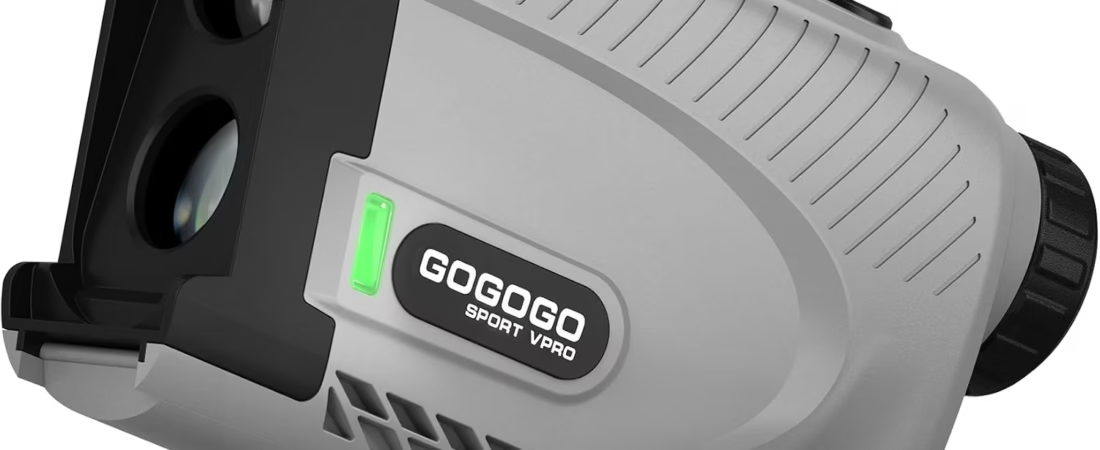
The Gogogo Sport Vpro Magnetic Golf Rangefinder with Slope Switch and Red OLED, associated with model GS26LG and Amazon ASIN B0DGSR4W45, is a Gen 2 laser rangefinder designed around this type of on-course measurement. Its documented specifications include 6X magnification, a stated maximum measuring range of 1,200 yards, a red OLED display, slope compensation, flag-lock functionality, vibration feedback, adjustable display brightness, an integrated magnet, and dual power options using a rechargeable lithium-ion battery with AAA backup support.
The device is not simply about producing a larger number on a screen. Its different functions address several practical aspects of golf distance measurement: identifying distant targets, measuring elevation differences, locating a flagstick among background objects, and keeping the rangefinder accessible on a golf cart.
This guide explains what these features mean, how a golfer might use the rangefinder during a round, the differences between laser and GPS distance measurement, and the factors worth considering before choosing this category of golf equipment.
Understanding a Laser Golf Rangefinder
A laser rangefinder measures the distance between the device and a selected target by sending a laser toward the target and analyzing the returning signal.
On a golf course, that target could be almost anything visible and relevant to the shot.
Examples include:
- A flagstick
- A bunker
- A water hazard
- A tree
- A fairway landing area
- A layup point
- A green-side feature
- A distant course landmark
This makes a laser rangefinder different from a conventional yardage marker. A marker usually provides a predetermined distance, while a laser allows the golfer to select a particular visible object.
The difference can become especially useful on unfamiliar courses.
Suppose a golfer wants to know not only the approximate distance to the green but also the distance to a bunker protecting the fairway. A laser can potentially provide both measurements.
The rangefinder therefore functions as a measurement tool. The golfer still needs to interpret the information, account for conditions, choose a club, and decide how aggressively to play the shot.
Key Features of the Gogogo Sport Vpro Rangefinder
6X Magnification
The GS26LG specifications identify 6X magnification.
Magnification enlarges the golfer’s view through the optical system, which can make distant targets easier to identify.
This can be useful when looking at a flagstick that is relatively small against a distant green. It may also help when the golfer needs to distinguish between a flag and surrounding trees, bunkers, or other background objects.
Magnification does not guarantee that every target will be easy to acquire. Atmospheric conditions, lighting, target size, hand movement, and the contrast between the target and its background can all affect the practical experience.
At higher magnification, stability becomes particularly important. A small movement of the rangefinder can appear much larger through the viewfinder.
Up to 1,200-Yard Measuring Range
The documented specifications list a measuring range of up to 1,200 yards.
A range of this size gives the device flexibility for measuring distant objects on and around a golf course.
For normal golf shots, golfers generally measure targets far closer than the maximum specification. The broader range can nevertheless be useful for viewing distant trees, landmarks, hazards, or other reference points.
It is important to distinguish maximum measuring range from reliable acquisition of every possible target.
A small flagstick, for example, can present a different challenge from a large reflective object. Target characteristics, visibility, weather, and stability can affect the ability to obtain a reading.
The published range should therefore be viewed as a specification rather than a promise that every object will be measured at that distance in every condition.
Red OLED Display
The rangefinder uses a red OLED display, with the manufacturer’s current GS26 product page describing a five-level adjustable red OLED display.
An OLED display allows the distance information to appear inside the optical viewing area rather than requiring the golfer to look away at a separate screen.
The red display can be particularly useful when viewing a darker environment or when the golfer wants the measurement information to remain visible without relying on a bright conventional display.
Brightness adjustment adds another layer of control. The manual describes five brightness levels, allowing the display to be adapted to different outdoor conditions.
Display brightness is a practical detail that can easily be overlooked when choosing a rangefinder. Outdoor golf can involve strong sunlight, cloudy skies, tree cover, and changing light throughout a round.
A display that can be adjusted gives the user more flexibility than a fixed brightness setting.
Ultra-Clear Optics and 99% Transmission Lens
Gogogo’s product information describes the GS26 as using multi-coated optics with 99% light transmission.
Light transmission is relevant because the optical system needs to deliver enough light to the viewer for the target to be identified.
Multi-coated lenses are commonly used in optical equipment to manage reflections and improve light transmission.
However, optical specifications should be interpreted in context. A high transmission figure does not eliminate the effects of fog, glare, rain, poor lighting, or atmospheric haze.
The golfer still needs a clear line of sight to the target.
Slope Compensation
Slope compensation is one of the most significant features of this rangefinder.
A conventional laser measurement gives the direct distance between the rangefinder and the target. On a level hole, that measurement can be relatively straightforward to interpret.
An uphill or downhill shot introduces another variable: elevation.
The GS26’s slope function calculates an adjusted distance based on elevation changes and displays information related to the angle and slope-adjusted distance.
Consider an uphill green.
The physical distance measured by the laser may be one number, while the shot may play differently because the target is substantially higher than the golfer.
Slope compensation provides additional information that can help the player consider that elevation difference.
It should not be interpreted as a complete prediction of ball flight. Wind, temperature, altitude, lie, club characteristics, ball flight, and the golfer’s own performance still matter.
Slope On/Off Function
The rangefinder includes a dedicated slope control. The manual describes the slope function as being activated or deactivated using the slope button, with an indicator showing when the feature is active.
This is important for golfers who play organized competitions.
Slope-adjusted distances may be restricted under applicable rules or local competition conditions. Having a dedicated way to disable the feature makes it possible to use the rangefinder for straight-line measurements when required.
Golfers should always verify the rules of the particular event they are playing rather than assuming that slope mode is permitted simply because the device can disable it.
Flaglock Function
The rangefinder includes a Flaglock function intended to help identify a flagstick among background objects.
According to the documentation, the system provides vibration feedback when a flag or flagpole is successfully locked. The published specifications describe flag-lock distances of up to 300 yards for flags and up to 350 yards for flagpoles.
This type of feature can be useful when the green contains several visual elements.
For example, a flag might stand in front of trees or other structures. The rangefinder’s flag-lock function is designed to help distinguish the intended target.
The vibration provides tactile confirmation, meaning the golfer does not need to rely entirely on watching the display.
Target acquisition is still influenced by visibility and aiming stability. The system should be viewed as an aid rather than an automatic guarantee of correct target identification.
Integrated Magnetic Mount
The rangefinder has a built-in magnet designed to attach to a golf cart or another suitable metal surface. Gogogo describes the magnet as a feature for attaching the unit to a golf cart bar or metal surface.
This can be useful during a round because a golfer does not necessarily want to keep the rangefinder loose inside a golf bag between every shot.
A magnetic mount can provide a convenient temporary storage position while the player is riding in a cart.
The strength and suitability of any magnetic attachment can depend on the specific surface, movement, and conditions. The rangefinder should be secured appropriately rather than assuming that a magnetic connection makes it impossible for the device to fall.
Dual Power Sources
The documented specifications identify a rechargeable lithium-ion power source with AAA backup support.
The inclusion of two power approaches provides flexibility.
A rechargeable system can be convenient for regular use when the rangefinder is charged before a round. Backup AAA batteries provide another option if the rechargeable power source is unavailable or depleted.
The manual also identifies a USB-C charging port and a power-source switch associated with the available power options.
Before playing, checking the battery indicator and power level is sensible. A rangefinder is most useful when it is ready to operate when needed.
How the Gogogo Sport Vpro Can Be Used on the Golf Course
Measuring the Flag
The most straightforward use is measuring the distance to the flag.
The golfer looks through the eyepiece, aligns the reticle with the target, and activates the measurement. The rangefinder can then provide the distance information through the OLED display.
The Flaglock function is designed to help acquire the flagstick and provide vibration feedback when the target is locked.
The resulting number can then be compared with the golfer’s normal club distances.
Measuring Bunkers
A bunker can be a more important target than the flag.
For example, a golfer may want to know how far it is to carry a fairway bunker before deciding which club to use from the tee.
The laser can be aimed at the bunker or another visible reference point.
This allows the golfer to think about risk and positioning rather than focusing exclusively on distance to the green.
Measuring Water Hazards
Water hazards are another useful application.
A golfer can measure a visible edge or reference point and compare the distance with their typical carry distances.
This can help the player understand whether a shot requires a particular club or whether another strategy is more appropriate.
The measurement does not make the decision for the golfer. It simply gives the golfer another piece of information.
Planning Layups
A laser rangefinder can also support layup strategy.
A golfer may not want to hit as close to the green as possible on every shot. There may be a preferred landing area that leaves a comfortable approach distance.
The player can measure visible landmarks and estimate where a shot should finish.
This can be particularly helpful on unfamiliar courses where the golfer has little prior knowledge of the hole.
Measuring Trees
Trees can serve as useful reference points.
A golfer may want to know how far away a tree is before attempting to hit over it, around it, or lay up before it.
The ability to select a specific visible object is one of the main differences between a laser rangefinder and fixed yardage markers.
Measuring Uphill and Downhill Targets
On a hilly course, the slope function can provide additional context.
The golfer can view the direct distance and slope-related information to understand how elevation changes the shot.
This is especially relevant on steep approach shots, elevated greens, downhill par threes, and other holes where elevation is visually obvious.
A Practical Distance-Measurement Routine
Using a rangefinder efficiently can become a simple routine.
Step 1: Identify the Target
Decide exactly what needs to be measured.
It might be the flag, the front of a bunker, a hazard, or a landing point.
Step 2: Establish a Stable Position
Hold the rangefinder steadily.
At 6X magnification, unnecessary movement can make the target harder to keep within the viewing area.
Step 3: Aim at the Target
Place the reticle over the desired object.
If background objects are close to the target, take a moment to ensure the device is aimed correctly.
Step 4: Activate the Measurement
Press the measurement button according to the operating instructions.
If the rangefinder locks onto a flag, the vibration provides additional feedback.
Step 5: Consider Slope
If slope mode is active, review the slope-related information alongside the direct measurement.
Think about the elevation difference rather than treating the adjusted number as an automatic club recommendation.
Step 6: Combine the Number With Your Own Data
Compare the measurement with known carry distances, typical shot patterns, wind, lie, and the intended landing area.
This turns the rangefinder from a simple measuring device into a practical part of course management.
Who May Find This Type of Rangefinder Useful?
Golfers Playing Unfamiliar Courses
Players who regularly visit different courses may appreciate the ability to measure visible targets without already knowing the hole layout.
Golfers Who Prefer Laser Measurements
Some golfers prefer looking through a physical optical device and aiming directly at a target rather than using a phone or GPS screen.
The Gogogo Sport Vpro follows this traditional laser-rangefinder workflow.
Players Who Play Hilly Courses
Slope compensation can be useful for golfers who frequently encounter substantial elevation changes.
Golfers Interested in Course Management
The device can measure more than flags. Players who plan around hazards, bunkers, trees, and landing zones can use the laser to gather additional information.
Golfers Who Use a Cart
The integrated magnet is particularly relevant for cart users because it provides a convenient attachment point for keeping the rangefinder accessible.
Important Things to Consider
Maximum Range Does Not Equal Maximum Practical Target Distance
The published 1,200-yard range is a specification, but not every target at that distance will be equally easy to acquire.
A large object may be easier to measure than a small flagstick.
Visibility, contrast, atmospheric conditions, and aiming stability all influence performance.
Flaglock Has Its Own Range
The documentation identifies specific flag and flagpole lock distances that are different from the overall measuring range.
This distinction is important.
A rangefinder may have a long general measuring range while its automated flag-lock function has a shorter practical range.
Understanding the difference helps set realistic expectations.
Slope Is an Aid, Not a Complete Shot Calculator
Slope compensation accounts for elevation but does not know every variable affecting the golf shot.
Wind direction and speed can be particularly important.
A golfer’s normal carry distance, ball flight, club selection, lie, and course conditions also matter.
The adjusted number should therefore be treated as one piece of information.
Check Slope Status Before Competitive Play
If slope compensation is not permitted in a competition, make sure the function is switched off.
The GS26 documentation specifically describes a dedicated slope control for turning the feature on or off.
Tournament rules can vary, so the relevant competition rules should always be checked.
Battery Planning Matters
The dual-power design provides flexibility, but golfers should still check the power level before a round.
If using the rechargeable battery, charging the device beforehand is a simple precaution.
If relying on backup AAA batteries, it is useful to understand the correct battery configuration before arriving at the course.
Weather Resistance Has Limits
The documentation identifies an IP54 rating for the GS26LG, meaning the device is designed for protection against dust and splashing water rather than submersion.
This distinction is important.
A splash-resistant rangefinder should not be treated as waterproof equipment that can safely be submerged or exposed to uncontrolled amounts of water.
Heavy rain can also make optical target acquisition more difficult even when the device itself remains protected from ordinary splashes.
Lens Care Is Important
The user manual advises against touching the coated lens surfaces with fingers.
Fingerprints can interfere with optical clarity.
Using an appropriate lens-cleaning cloth and following the manufacturer’s cleaning instructions can help keep the viewing system clear.
Red OLED Displays and Outdoor Visibility
Outdoor visibility can change considerably throughout a golf round.
A player may begin in bright morning sunlight, move under tree cover, and finish when the light is significantly lower.
The red OLED system is designed to make the information visible through the optical display, while adjustable brightness allows the golfer to adapt the display to different conditions. Gogogo’s current product information describes five brightness levels.
A very bright display is not necessarily the most useful setting in every situation. Excessive brightness can become distracting in darker surroundings, while insufficient brightness can make information harder to read in strong light.
Being able to adjust the display provides a practical way to balance those conditions.
Rangefinder vs. GPS Golf Devices
Laser rangefinders and GPS golf devices solve the distance problem differently.
A GPS device uses mapped course information to estimate distances to predefined points. Depending on the system, it may show the front, middle, and back of a green, hazards, hole layouts, and other course features.
A laser rangefinder measures physical targets that the golfer can see.
This makes the two approaches complementary in many situations.
GPS can be useful when the target is hidden or when the golfer wants a broader hole map.
Laser measurement can be useful when the golfer wants the distance to a particular tree, bunker, flag, or other visible object.
The choice depends largely on how the golfer prefers to gather information.
Rangefinder vs. Smartphone Golf Apps
Smartphone golf applications can provide GPS yardages, scorekeeping, maps, statistics, and other information.
Their major advantage is versatility.
A laser rangefinder has a narrower purpose but a direct measurement workflow.
Instead of opening an application and interpreting a course map, the golfer can look through the optical system and aim at the target.
For players who prefer dedicated equipment for distance measurement, this can be a meaningful distinction.
Rangefinder vs. Traditional Yardage Markers
Traditional yardage markers remain valuable because they are simple and do not require batteries.
They can provide standardized reference distances, such as the distance to the center of a green.
The limitation is that the marker cannot necessarily answer every target-specific question.
A laser rangefinder can potentially measure the exact visible object the golfer is interested in.
Using both approaches can provide useful cross-checking information during a round.
Rangefinder vs. Dedicated Golf GPS Watch
A GPS golf watch provides information directly on the wrist and can be convenient for golfers who prefer not to carry a separate device.
It may show hole layouts, distances, and other information depending on the model and software.
A laser rangefinder provides direct line-of-sight measurement and optical magnification.
Golfers who prefer a physical target measurement process may favor the laser format, while golfers who value hands-free information may prefer a GPS watch.
These categories are designed around different workflows rather than being interchangeable in every situation.
Tips for Getting More Useful Measurements
Measure the Relevant Target
The most accurate measurement is not necessarily the most useful one.
If a bunker is the main hazard, measuring the flag does not answer the question the golfer actually needs to solve.
Start with the decision and then measure the target relevant to that decision.
Use Multiple Measurements When Planning a Hole
On a par 5, for example, a golfer may want several numbers:
- Distance to a fairway bunker
- Distance to a preferred landing area
- Distance to a second hazard
- Distance to the green
This can provide a more complete picture of the hole.
Keep the Rangefinder Steady
At 6X magnification, stability helps with both target identification and measurement.
A two-handed grip can make the device easier to hold steady.
Adjust OLED Brightness
Use the available brightness settings to suit the conditions.
Strong sunlight may require a different setting from shaded areas or lower-light conditions.
Confirm the Unit
The manual supports yards, meters, and feet.
Make sure the desired unit is selected before starting a round.
Accidentally using meters when expecting yards can create a significant difference in club selection.
Learn Your Carry Distances
The rangefinder tells you how far away the target is.
It does not tell you how far you personally hit a club.
Knowing your approximate carry distances makes the measured numbers much more useful.
Care, Storage, and Maintenance
A golf rangefinder is exposed to dust, grass, changing temperatures, and movement inside a golf bag.
Keeping it in the supplied carrying case when it is not being used can help protect the device. The documentation identifies a carrying case, lanyard, USB-C charging cable, user manual, and lens cleaning cloth among the included components.
The optics should be kept clean, but users should avoid touching coated lens surfaces unnecessarily.
The device should also be stored away from extreme temperatures and excessive moisture.
If the rangefinder becomes exposed to water beyond its rated protection, follow the manufacturer’s care instructions rather than assuming the device can continue operating normally.
Frequently Asked Questions
What is the maximum measuring range of the Gogogo Sport Vpro Gen 2?
The GS26LG documentation lists a measuring range of up to 1,200 yards.
The ability to measure a particular target at long distances depends on target characteristics and environmental conditions.
What magnification does it have?
The documented specification lists 6X magnification.
Does it have slope compensation?
Yes. The GS26LG includes golf slope compensation that considers elevation differences when calculating the adjusted distance.
Can the slope feature be turned off?
Yes. The rangefinder includes a dedicated slope control for activating or deactivating the slope function.
This is particularly relevant when using the rangefinder under competition rules that restrict slope-adjusted information.
Does it have a red OLED display?
Yes. The GS26 is documented with a red OLED display and adjustable brightness. Gogogo’s product information describes five brightness levels.
Can the display brightness be adjusted?
Yes. The user manual describes five brightness levels for the OLED display.
Does it lock onto golf flags?
The rangefinder includes a Flaglock function designed to help acquire flagsticks and provide vibration feedback when a target is successfully locked.
How far can the Flaglock function work?
The documentation lists flag-lock capability up to 300 yards and flagpole locking up to 350 yards.
These figures are separate from the overall 1,200-yard measuring specification.
Does the rangefinder vibrate?
Yes. The documentation describes vibration feedback when the flag or flagpole is successfully locked.
Does it have a magnet?
Yes. The GS26 includes an integrated magnet designed for attachment to a golf cart or other suitable metal surface.
What power source does it use?
The documented GS26LG specifications identify a rechargeable lithium-ion battery with AAA backup support.
The manual also identifies a USB-C charging port and power-source controls.
Can it measure yards and meters?
Yes. The manual describes switching between yards, meters, and feet.
Is it waterproof?
The GS26LG documentation identifies an IP54 rating, which indicates protection against dust and splashing water rather than submersion.
It should therefore not be treated as a fully waterproof device.
Can it be used in rain?
The IP54 rating provides some protection against splashing water, but golfers should still avoid unnecessary exposure to heavy rain and follow the manufacturer’s instructions.
Rain and fog can also make it more difficult to see and acquire distant targets.
Can it replace a GPS golf device?
Not necessarily.
A laser rangefinder measures visible targets directly, while GPS systems provide mapped course information. Each approach has different strengths.
Is it useful for beginners?
It can provide beginners with a practical way to learn actual distances on the course.
However, beginners still need to learn their own club distances and basic course-management principles. Knowing the distance does not automatically determine the correct club.
Can it measure bunkers and trees?
Yes. A laser rangefinder can be aimed at visible objects such as bunkers, trees, hazards, and other course landmarks.
Does slope compensation account for wind?
No. Slope compensation is concerned with elevation and angle. Wind and other playing conditions must be considered separately.
What should I do if the rangefinder does not lock onto the flag?
Check that the flag is within the practical Flaglock range, stabilize the device, improve your aim, and try again.
The documentation also notes that background interference and extreme weather can make acquisition more difficult.
How should the lenses be cleaned?
The user manual advises against touching the coated lens surfaces with fingers.
Use the supplied cleaning cloth or another appropriate optical-cleaning method while following the manufacturer’s instructions.
Conclusion
The Gogogo Sport Vpro Magnetic Golf Rangefinder with Slope Switch and Red OLED is designed around a straightforward concept: give golfers a compact optical tool for measuring visible distances while adding features that can help with target identification, elevation, and on-course convenience.
The documented GS26LG specifications include 6X magnification, a stated measuring range of up to 1,200 yards, a red OLED display with adjustable brightness, slope compensation, Flaglock with vibration feedback, an integrated magnet, and dual power options involving a rechargeable lithium-ion battery and AAA backup.
For everyday golf, the rangefinder can be used to measure flags, bunkers, hazards, trees, layup points, and other visible targets. The ability to measure a specific object gives laser rangefinders a different role from GPS systems and fixed course yardage markers.
The slope function adds another layer of information for uphill and downhill shots. Because slope-adjusted distances can be restricted in certain competitions, the dedicated slope control is an important practical feature for golfers who move between casual rounds and organized play. Players should always verify the rules that apply to their particular event.
The red OLED display and adjustable brightness are also relevant to outdoor use, where lighting conditions can change considerably during a round. Meanwhile, the integrated magnet can make the rangefinder easier to keep accessible when using a golf cart.
At the same time, golfers should keep the specifications in context. A 1,200-yard maximum range does not mean every target will be equally easy to acquire at that distance. Flaglock has its own stated operating range, weather can affect visibility, and slope compensation does not account for every factor that influences a golf shot.
The most useful role for a laser rangefinder is therefore as a source of information. It can provide a distance, but the golfer remains responsible for interpreting that number alongside club distances, wind, elevation, lie, hazards, and overall course strategy.
For golfers researching a compact laser rangefinder with slope control, red OLED viewing, flag-lock assistance, magnetic cart attachment, and flexible power options, the Gogogo Sport Vpro Gen 2 provides a feature set centered on practical distance measurement.